Introduction
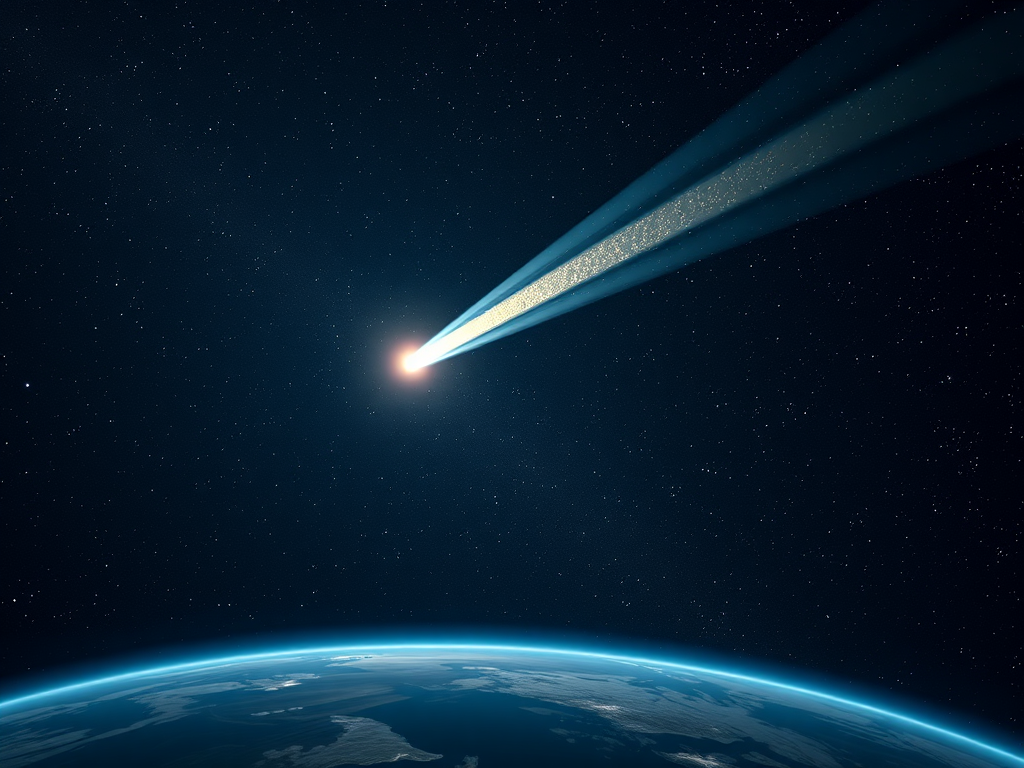
Imagine a cosmic traveler that has journeyed for millions of years through the void between stars, only to briefly pass through our corner of the galaxy. On December 19, 2025, 3I/ATLAS will make its closest approach to Earth, marking a historic moment in astronomy. This interstellar comet is only the third confirmed object detected from beyond our solar system. The first two were ‘Oumuamua in 2017 and comet 2I/Borisov in 2019.
Table of Contents
- Introduction
- What Makes 3I/ATLAS an Interstellar Visitor
- The Scientific Significance of Studying 3I/ATLAS
- The Alien Technology Debate and Scientific Consensus
What makes this event particularly exciting? Scientists have never had such advanced technology ready to study an interstellar visitor. With the James Webb Space Telescope, Hubble, and multiple spacecraft positioned to observe this rare phenomenon, researchers are gathering unprecedented data. They are studying the material formed around a distant star. The information 3I/ATLAS carries could reveal secrets about planetary formation in other star systems. It could also indicate whether conditions for life exist elsewhere in our galaxy. As this cosmic messenger speeds through our celestial neighborhood at over 153,000 miles per hour, it presents a once-in-a-generation opportunity. It allows us to examine the chemistry and composition of an alien star system. Remarkably, we can do this without ever leaving home.
What Makes 3I/ATLAS an Interstellar Visitor

Discovery and Trajectory
The ATLAS (Asteroid Terrestrial-impact Last Alert System) survey telescope in Chile first spotted 3I/ATLAS on July 1, 2025. Within days, astronomers recognized something extraordinary in the comet’s path. Unlike objects born in our solar system that follow elliptical orbits around the Sun, 3I/ATLAS travels on a hyperbolic trajectory—a telltale sign of interstellar origin.
Think of it this way: solar system comets are like boomerangs that always return. Interstellar objects are arrows shot from distant bows, passing straight through and never coming back. The comet’s trajectory calculations showed it entered our solar system from the direction of the constellation Lyra. It had traveled through interstellar space for potentially millions of years before its brief encounter with our Sun.
Key Characteristics That Confirm Interstellar Origin
Several distinctive features confirm 3I/ATLAS came from beyond our solar system. Its velocity at perihelion (closest approach to the Sun) reaches an astounding 153,000 mph—far exceeding the escape velocity needed to break free from the Sun’s gravitational pull. This speed alone proves it’s not gravitationally bound to our star.
The comet’s chemical signature also stands out. Observations reveal an unusually carbon dioxide-rich coma (the glowing cloud of gas and dust surrounding the nucleus) with surprisingly low water content compared to typical solar system comets. Perhaps most striking is its distinctive anti-tail feature—a rare phenomenon where dust appears to point toward the Sun rather than away from it. This anti-tail forms when Earth passes through the comet’s orbital plane. It creates an optical illusion that has captivated both professional astronomers and amateur skywatchers alike.
The Scientific Significance of Studying 3I/ATLAS
Chemical Composition and What It Reveals
The chemical makeup of 3I/ATLAS is rewriting what scientists thought they knew about comet formation. James Webb Space Telescope observations detected carbon dioxide levels nearly three times higher than typical solar system comets, while water—usually the dominant volatile in comets—appears remarkably scarce. What does this tell us?
These chemical differences suggest 3I/ATLAS formed in a stellar environment quite different from our own. The high CO₂-to-water ratio indicates it likely originated in a colder region of its home star system, possibly in the equivalent of our Kuiper Belt but around a star with different characteristics. Some researchers speculate it could have formed around a red dwarf star, where conditions favor carbon dioxide ice over water ice. This compositional analysis allows scientists to study another star system’s chemistry. They can achieve this without sending a probe across light-years of space. It is a remarkable achievement.
Multi-Spacecraft Observation Campaign
The scientific community mobilized an unprecedented observation campaign for the 3I/ATLAS comet close approach. NASA’s Lucy spacecraft, originally en route to study Jupiter’s Trojan asteroids, adjusted its instruments to capture valuable data during the comet’s passage. The Psyche mission and even MAVEN orbiting Mars contributed observations from their unique vantage points.
The European Space Agency’s XMM-Newton X-ray observatory detected unexpected X-ray emissions from the comet. This phenomenon might result from solar wind interactions with its unusual chemical composition. Meanwhile, ground-based telescopes across six continents coordinated viewing schedules to maintain continuous coverage. This multi-wavelength, multi-platform approach has generated the most comprehensive dataset ever collected on an interstellar object, with terabytes of information that will keep researchers busy for years analyzing the findings.
The Alien Technology Debate and Scientific Consensus

Controversial Claims and Evidence
Prominent Harvard astrophysicist Avi Loeb made a suggestion about 3I/ATLAS. He proposed it might warrant investigation for signs of extraterrestrial technology. The astronomy community took notice, though not necessarily in agreement. Loeb pointed to the comet’s precise trajectory alignment with several nearby star systems. He also noted an unusual nickel-to-iron ratio in spectroscopic data. These could be potential indicators of artificial origin.
His arguments gained traction in popular media, sparking widespread public fascination. Some speculated the anti-tail feature could be an artificial structure or that the trajectory represented intentional targeting. The debate highlighted humanity’s deep-seated hope for contact with alien intelligence, even as most scientists remained skeptical of the technological hypothesis.
Why Scientists Confirm It’s a Natural Comet
The scientific consensus firmly supports a natural origin for 3I/ATLAS. Recent studies have documented non-gravitational acceleration. This is consistent with outgassing. When solar heating causes volatile materials to vaporize, they jet away from the comet and create small thrust. This behavior is entirely typical for comets and explains trajectory peculiarities that initially seemed mysterious.
The unusual chemical composition, rather than suggesting artificial construction, actually strengthens the case for natural formation in a different stellar environment. Subsequent analyses showed that the nickel-to-iron ratio falls within the range observed in metallic meteorites. This ratio is likely caused by the comet’s unique formation conditions. The search for extraterrestrial intelligence remains a legitimate scientific pursuit. However, 3I/ATLAS displays all the hallmarks of a natural cosmic snowball. It is simply one formed under different stellar conditions than our own solar system comets.
Frequently Asked Questions
How close will 3I/ATLAS get to Earth?
3I/ATLAS will pass Earth at a safe distance of approximately 1.8 astronomical units (about 168 million miles) on December 19, 2025. To put this in perspective, that’s nearly twice the distance between Earth and the Sun, posing absolutely no danger to our planet.
Can I see 3I/ATLAS with the naked eye?
No, 3I/ATLAS requires at least a moderate telescope or powerful binoculars to observe. It appears as a faint, diffuse glow in the predawn sky, with experienced amateur astronomers reporting it reaches about magnitude 10—roughly 40 times fainter than the dimmest stars visible to the unaided eye.
What is an interstellar comet?
An interstellar comet is a comet that originated outside our solar system, traveling through the space between stars until gravitational interactions brought it near our Sun. Unlike solar system comets that orbit the Sun repeatedly, interstellar comets have hyperbolic trajectories. These trajectories carry them through our cosmic neighborhood only once. Afterward, they depart forever.
Will 3I/ATLAS ever return to Earth?
No, 3I/ATLAS is on a one-way journey through our solar system. Its hyperbolic trajectory means it will exit our Sun’s gravitational influence. It will continue traveling through interstellar space indefinitely. It will never return to Earth or our solar system again.
What makes 3I/ATLAS different from regular comets?
3I/ATLAS exhibits unusually high carbon dioxide content with remarkably low water levels compared to solar system comets, suggesting formation in a different stellar environment. It also displays a rare anti-tail feature. It travels at speeds exceeding solar escape velocity. These observations confirm its interstellar origin and one-way passage through our cosmic neighborhood.
Conclusion
3I/ATLAS represents far more than a cosmic curiosity passing through our solar system. This interstellar visitor offers a tangible connection to distant star systems, carrying chemical fingerprints that reveal conditions around alien suns. The comet continues its journey back into the depths of interstellar space. This follows its December 19, 2025 close approach. The data collected by observatories and spacecraft worldwide will fuel scientific discoveries for decades to come. You might track it through a telescope. Or you might marvel at the reality that material from another star system is passing through our celestial neighborhood. 3I/ATLAS reminds us that the universe is more interconnected. It is also more accessible to study than we might imagine.
Leave a Reply