
Introduction

Picture a traveler from another star system, racing through the darkness of space for millions of years, finally reaching our cosmic doorstep. That’s exactly what’s happening right now. NASA has confirmed the detection of interstellar comet 3I/ATLAS, marking only the third time astronomers have identified an object originating from beyond our solar system. This discovery is electrifying the astronomy community for good reason—unlike the fleeting glimpses we got of previous interstellar visitors, 3I/ATLAS offers a rare window to study material that was forged around distant stars.
Table of Contents
- Introduction
- What Makes Comet 3I/ATLAS Different from Previous Interstellar Visitors
- How NASA Detects and Tracks the Interstellar Comet
- Scientific Significance: What We Can Learn About the Universe
Why does this matter now? Since the first confirmed interstellar object, ‘Oumuamua, streaked past us in 2017, scientists have been scrambling to develop better detection systems and response protocols. Each new visitor teaches us something profound about the universe beyond our Sun’s influence. The discovery of this third interstellar visitor demonstrates that these cosmic wanderers might be more common than we thought—and we’re finally getting better at spotting them.
What Makes Comet 3I/ATLAS Different from Previous Interstellar Visitors

Comparing 3I/ATLAS to Oumuamua and 2I/Borisov
The story of interstellar visitors reads like a cosmic evolution. First came ‘Oumuamua in 2017—a cigar-shaped mystery that baffled scientists with its unusual tumbling motion and possible acceleration. By the time astronomers realized what they had discovered, it was already leaving. Then 2I/Borisov arrived in 2019, and this one behaved more predictably, showing clear comet-like characteristics with its bright coma and tail.
Now, interstellar comet 3I/ATLAS brings its own personality to the table. According to NASA’s initial observations, this visitor displays a more pronounced cometary activity than Borisov did at similar distances from the Sun. Its brightness variations suggest active outgassing—the sublimation of frozen materials into gas as solar radiation warms its surface. What’s particularly exciting is the detection timeline: astronomers spotted 3I/ATLAS earlier in its approach than the previous two objects, giving researchers months rather than weeks to prepare observation campaigns.
The physical differences tell a fascinating story about diversity among interstellar objects. While ‘Oumuamua’s reddish hue suggested a surface rich in organic compounds, and Borisov’s composition closely matched comets from our own Oort cloud, early spectroscopic data from 3I/ATLAS hints at unique chemical signatures that scientists are still working to decode.
Trajectory and Composition Insights
The orbital path of 3I/ATLAS reveals it’s taking a sharper angle through the solar system compared to its predecessors, entering from a region near the constellation Perseus. Its hyperbolic trajectory—meaning its path is open-ended rather than closed—confirms without doubt that it’s just passing through, never to return. The velocity measurements show it’s traveling at approximately 35 kilometers per second relative to the Sun, carrying kinetic energy that dwarfs anything human spacecraft have achieved.
Composition analysis represents the real scientific goldmine. Early observations suggest water ice, carbon monoxide, and possibly cyanide compounds in its coma—the fuzzy atmosphere surrounding the nucleus. These materials provide direct samples of chemistry from another star system, essentially allowing scientists to study sky worlds without leaving our own neighborhood. The comet’s dust-to-gas ratio, which affects how its tail appears, differs from typical solar system comets, suggesting different formation conditions in its home system.
How NASA Detects and Tracks the Interstellar Comet
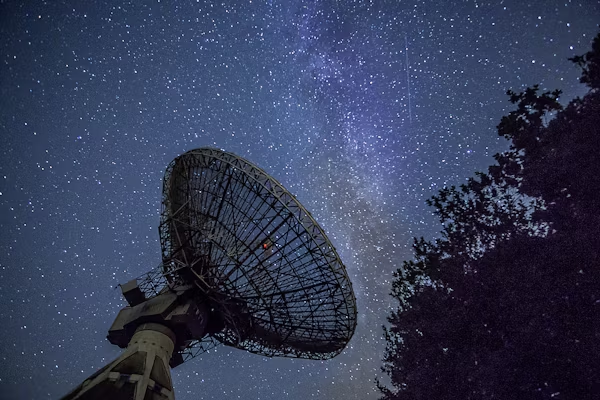
Detection Technology and Methods
The detection of interstellar comet 3I/ATLAS showcases humanity’s improving astronomical surveillance capabilities. The ATLAS (Asteroid Terrestrial-impact Last Alert System) survey, ironically designed to spot Earth-threatening asteroids, made the initial detection. This network of four telescopes in Hawaii and South Africa scans the entire visible sky every two nights, capturing images that are automatically compared to previous observations. Any object that moves gets flagged for further analysis.
What happens next involves sophisticated orbital calculations. When ATLAS identified a fast-moving object with unusual characteristics, astronomers immediately began tracking its position across multiple nights. By plotting these positions, they calculated its orbit backward and forward in time. The key measurement is orbital eccentricity—a value greater than 1.0 indicates the object is on a hyperbolic trajectory and therefore not bound to our Sun. 3I/ATLAS scored well above this threshold, definitively proving its interstellar origin.
Current Location and Visibility
As of the latest NASA tracking data, 3I/ATLAS is in the inner solar system, having crossed the orbit of Jupiter and continuing its inbound journey. Its current position places it several astronomical units from Earth—still far beyond Mars but approaching the region where solar heating intensifies cometary activity. The comet’s path will bring it closest to the Sun (perihelion) in the coming months, after which it will slingshot back out toward interstellar space, never to return.
Can amateur astronomers observe this cosmic visitor? The answer is cautiously optimistic. With the right equipment—a telescope with at least 8-10 inches of aperture and dark skies—dedicated observers may capture 3I/ATLAS as a faint smudge against the background stars. However, it won’t look like the dramatic comets you see in photos. Think of it as a challenge observation rather than a naked-eye spectacle. NASA’s Jet Propulsion Laboratory maintains updated ephemerides (position tables) that help amateur astronomers know exactly where to point their telescopes.
Scientific Significance: What We Can Learn About the Universe

Clues About Other Star Systems
Every interstellar visitor is essentially a free space probe from another star system, delivering samples we could never afford to retrieve ourselves. The chemical makeup of interstellar comet 3I/ATLAS provides direct evidence about conditions around its parent star—wherever that might be. The presence of specific ices, organic molecules, and dust grains reflects the temperature, composition, and age of the protoplanetary disk where it formed billions of years ago.
Scientists are particularly interested in comparing the isotopic ratios of elements like hydrogen, carbon, and oxygen in 3I/ATLAS to those found in solar system comets. Isotopes are versions of elements with different numbers of neutrons, and their ratios act like chemical fingerprints that reveal formation conditions. If 3I/ATLAS shows significantly different ratios, it confirms that planetary system formation can vary substantially between stars—valuable data for understanding exoplanets orbiting distant suns.
Future Research Opportunities
The detection of three interstellar objects in less than a decade suggests we’re crossing a threshold in observational astronomy. The upcoming Vera C. Rubin Observatory, set to begin operations soon, will scan the sky with unprecedented depth and frequency, likely detecting dozens of interstellar visitors each year. This will transform interstellar objects from rare curiosities into a regular field of study, enabling statistical analysis of their properties and origins.
For 3I/ATLAS specifically, astronomers worldwide are coordinating observation campaigns across the electromagnetic spectrum. Radio telescopes are searching for unusual molecules, infrared observations map the temperature distribution across its surface, and ultraviolet studies track the breakdown of molecules in its coma. One ambitious proposal involves deploying space-based telescopes to maintain continuous observation as the comet approaches perihelion—the moment of maximum activity and scientific return.
Frequently Asked Questions
Is interstellar comet 3I/ATLAS dangerous to Earth?
No, NASA confirms 3I/ATLAS poses absolutely zero threat to Earth as its trajectory keeps it well beyond the orbit of Mars at its closest approach. The comet’s hyperbolic path ensures it will never return, and even if its orbit were different, comets of this size don’t cause extinction-level events—those require objects hundreds of times larger.
How do scientists know 3I/ATLAS is from outside our solar system?
Scientists calculate the comet’s orbital eccentricity, which measures how elongated its path is—values above 1.0 indicate a hyperbolic trajectory not bound by the Sun’s gravity. Additionally, its excessive velocity and the trajectory’s origin point from interstellar space definitively confirm it formed around a different star and is merely passing through our solar system.
Can I see interstellar comet 3I/ATLAS with a telescope?
Visibility depends on the comet’s current brightness and your equipment, but experienced amateur astronomers with 8-10 inch telescopes and dark skies have a reasonable chance of detecting it as a faint, fuzzy object. Check NASA’s Minor Planet Center or astronomy apps for updated coordinates and magnitude predictions, though it won’t resemble the bright comets visible to the naked eye.
What happened to the first interstellar objects Oumuamua and Borisov?
Both ‘Oumuamua and 2I/Borisov have exited our solar system and continue their solitary journeys through the interstellar void, traveling at speeds that will eventually carry them to other star systems over millions of years. They’re now far beyond the range of even our most powerful telescopes, lost again in the vast darkness between the stars.
How often do interstellar objects visit our solar system?
Current estimates suggest several interstellar objects pass through our solar system each year, though most remain undetected due to their small size, high speed, or simply because they don’t pass close enough to Earth’s observatories. As detection technology improves, astronomers expect to catalog many more of these visitors, revealing just how interconnected our galaxy truly is.
Conclusion
The discovery of interstellar comet 3I/ATLAS represents far more than another checkmark in the astronomical record books—it’s a reminder that our solar system exists within a galactic ecosystem where objects routinely exchange between star systems.
Leave a Reply