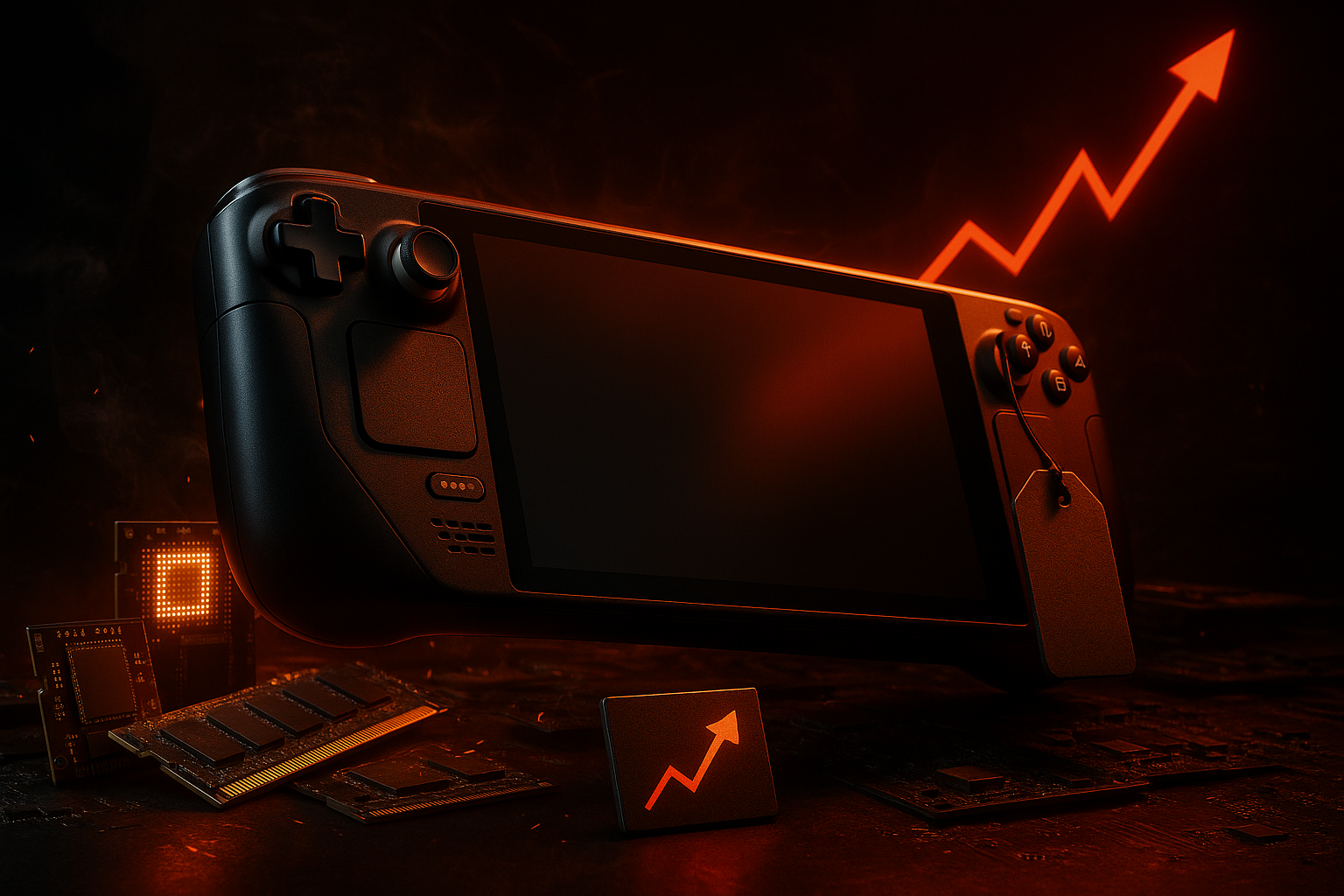
Valve just raised the Steam Deck OLED price by up to $300 overnight — and the hardware inside the device didn’t change by a single component. The Steam Deck OLED price increase landed on May 27, 2026, catching gamers off guard and sparking immediate backlash across Reddit and gaming forums. But Valve isn’t the villain here. It’s the victim of a global memory market that’s been quietly tilting away from consumer electronics for over a year.
The force reshaping that market is AI infrastructure. Data centers are consuming semiconductor supply at a scale the industry wasn’t built to handle, and everyday consumers — gamers included — are absorbing the cost. With DRAM contract prices up nearly 90% in a single quarter, what’s happening to the Steam Deck is just the most visible symptom of a much larger problem.
—
What Changed: The Steam Deck OLED New Prices and Valve’s Explanation
The Numbers: A $240–$300 Overnight Jump
The price increases hit both OLED configurations hard. The 512GB model jumped from $549 to $789 — a $240 increase. The 1TB model climbed from $649 to $949, a full $300 more than before. That’s a 44–46% price hike with zero change to the product itself.
Refurbished units offer some relief. Valve is holding those at $629 (512GB) and $759 (1TB), making certified refurbished stock the most rational buy right now for anyone who still wants in. Still, even refurbished pricing reflects just how far the baseline has shifted.
Valve’s Official Statement and What It Omits
Valve’s statement cited “rising memory and storage costs” and “global logistical challenges” — including supply chain disruptions linked to the Strait of Hormuz closure — as the primary drivers. The language was measured and corporate. What was missing: any hint of a timeline for relief.
Valve offered no indication that prices would return to previous levels. That silence is telling. When a company doesn’t promise a rollback, it’s usually because one isn’t coming. The omission suggests Valve’s procurement team sees elevated component costs as the new normal, not a temporary disruption to wait out.
—
The Root Cause: AI Data Centers Are Consuming the World’s Memory Supply
How AI Infrastructure Outbids Consumer Electronics for DRAM and NAND
The root of this problem is structural. AI firms — training and running large language models, vision systems, and inference infrastructure — require massive volumes of high-bandwidth memory. They’re placing open-ended purchase orders, willing to pay whatever the market demands.
That leaves Samsung, SK Hynix, and Micron with an easy decision: redirect production toward high-margin enterprise chips like HBM and DDR5 RDIMMs, and scale back consumer NAND and DRAM output. Consumer electronics manufacturers end up competing for what’s left. TrendForce projects that AI-focused systems will consume 70% of global high-end memory chip output in 2026.
By the Numbers: How Severe Is the 2026 Memory Crisis?
The data is striking. DRAM contract prices surged 80–90% in Q1 2026 alone, with another 58–63% quarter-over-quarter increase projected for Q2. Consumer RAM prices inflated up to 110%. SSD prices surged 147% in the same period.
This is what some analysts are calling “RAMageddon 2026.” Samsung and SK Hynix — together controlling roughly 90% of global DRAM supply — have publicly warned that supply will fall short of demand through 2027. There’s no cavalry coming. The NAND flash price spike is real, and it has a long runway ahead.
—
What’s Next: Steam Machine at Risk and the Broader Gaming Hardware Fallout
Steam Machine and Steam Frame VR: Collateral Damage?
Valve’s Steam Machine was already delayed from its originally expected Q1 2026 window into an undefined release date. The Steam Deck price hike makes the Steam Machine release date in 2026 look increasingly optimistic. The device uses newer, more memory-intensive components than the Steam Deck — meaning its bill of materials is even more exposed to the current crisis.
If Valve couldn’t hold Steam Deck pricing, it’s difficult to see how it prices the Steam Machine competitively at launch. A 2027 slip is plausible. And when it does arrive, expect a retail price that reflects today’s component reality, not 2024 projections.
FAQ: Key Questions from Gamers in 2026
Is the Steam Deck OLED price increase permanent?
Valve has given no rollback timeline. With memory prices projected to stay elevated through 2027, a return to $549/$649 pricing appears unlikely in the near term.
Is the Steam Deck still worth buying in 2026?
The refurbished units at $629 and $759 represent the best remaining value. New units at $789–$949 put the Steam Deck in a price tier that deserves serious comparison shopping.
Are other consoles affected too?
Yes. Sony raised PS5 pricing to $649.99 in April 2026. Nintendo raised the Switch 2 MSRP by $50. Microsoft added $150 to the 1TB Xbox Series X. The RAM shortage 2026 gaming impact is industry-wide, not Valve-specific.
How much will this affect the PC market overall?
IDC estimates memory price hikes will cause a 9% dip in PC sales and a 5% decline in smartphone sales across 2026 as manufacturers pass costs to consumers.
—
Conclusion
The Steam Deck OLED price increase is a structural reset, not a pricing anomaly. Valve is one of many hardware makers caught in a semiconductor reallocation driven by AI infrastructure investment — and the data from Samsung, SK Hynix, and TrendForce all point to elevated memory prices persisting well into 2027. For US gamers, the practical advice is simple: refurbished is the smart buy right now, the Steam Machine’s pricing outlook has gotten significantly worse, and the era of sub-$600 premium handheld gaming may be on pause for a while. Whether that changes depends less on Valve than on how quickly memory supply catches up to an AI industry that shows no signs of slowing down.
Leave a Reply