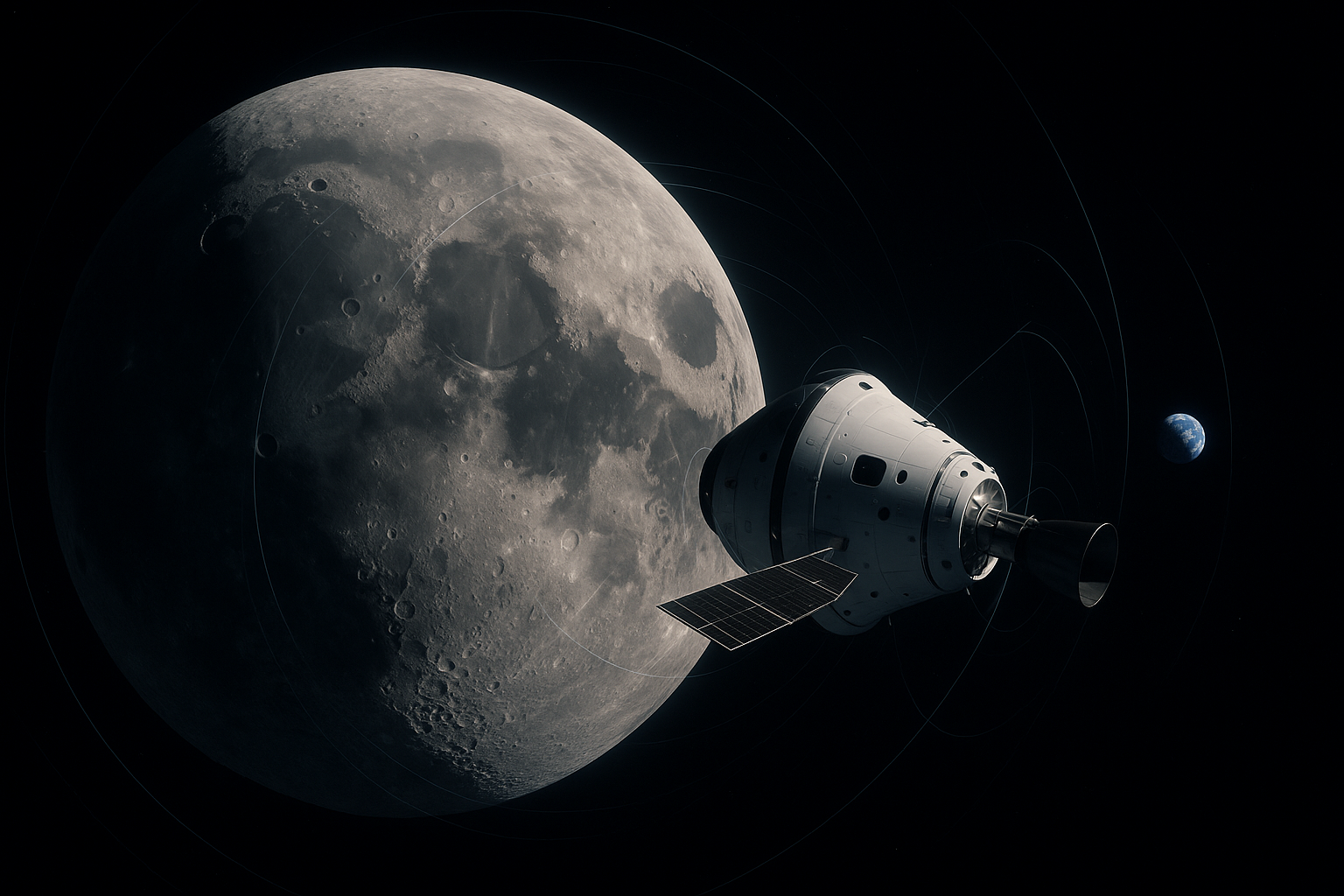
On April 1, 2026, NASA launched Artemis II atop the Space Launch System rocket from Kennedy Space Center — and the world has been watching ever since. Six days later, the four-person crew aboard Orion Integrity has already rewritten the history books. They flew around the far side of the Moon, witnessed a solar eclipse from deep space, and shattered a 56-year-old distance record held by Apollo 13.
This Artemis 2 tracker guide gives you everything in one place: where the spacecraft is right now, what the crew has accomplished, and exactly what to expect before splashdown. Whether you’re a lifelong space fan or just tuning in for the first time, here’s the full picture.
—
Where Is Artemis II Right Now? Live Mission Status
Six days into the mission, Orion has completed the most dramatic leg of its journey. Now comes the long ride home.
Current Location and Speed of Orion
After completing its 7-hour lunar flyby on April 6, Orion exited the Moon’s gravitational sphere of influence on April 7 at approximately 1:25 p.m. EDT — about 41,072 miles from the lunar surface. The spacecraft is now on a return trajectory toward Earth, decelerating as it climbs out of the Moon’s gravity well.
At its closest lunar approach, Orion reached speeds of roughly 60,863 mph relative to Earth. That number is dropping steadily as the spacecraft coasts homeward. You can follow the Orion spacecraft location in real time at nasa.gov/trackartemis — NASA updates the live feed continuously throughout the mission.
Key Milestones Already Completed
The crew has packed an extraordinary amount into six days. Here’s what’s already locked into the record books:
- New human spaceflight distance record: 252,756 miles from Earth — surpassing Apollo 13’s 248,655-mile record by 4,111 miles
- Lunar flyby completed: A full 7-hour pass including a 40-minute communications blackout behind the Moon
- Solar eclipse from deep space: The crew observed a nearly 54-minute solar eclipse — an experience no humans had ever had before
- Far side photography: The crew captured detailed images of the lunar far side, including the Orientale Basin
- Historic first: Christina Koch became the first woman ever to complete a crewed lunar flyby
- NASA+ (free, no subscription required)
- NASA’s YouTube channel (live 24/7 coverage)
- Streaming platforms: Netflix, Amazon Prime, Apple TV, Hulu, HBO Max, and Roku
- Real-time updates at the official Artemis mission blog on nasa.gov
- Social media: follow @NASAArtemis for moment-by-moment updates
Each of these milestones feeds directly into planning for Artemis III, the first crewed Moon landing since 1972, currently targeted for 2028.
—
The Artemis II Crew: Who Is on Board and What Are They Doing?
This crew didn’t just make history — each member is history.
Meet Reid Wiseman, Victor Glover, Christina Koch & Jeremy Hansen
The Artemis II mission 2026 crew represents a landmark moment in human spaceflight. NASA Commander Reid Wiseman leads the mission, with Victor Glover serving as Pilot — becoming the first Black astronaut to travel to lunar distance. Mission Specialist Christina Koch is the first woman to fly a crewed lunar flyby. Canadian Space Agency Mission Specialist Jeremy Hansen is the first Canadian to travel beyond Earth orbit.
Together, they are the first humans to venture beyond low Earth orbit since the Apollo 17 crew did so in December 1972 — over 50 years ago. That context is worth sitting with for a moment.
What the Crew Is Testing on the Return Home
The return leg isn’t downtime. Days 7 through 10 are packed with critical work. The crew is performing trajectory correction burns to fine-tune Orion’s re-entry angle, running manual piloting tests of the spacecraft’s systems, and completing a radiation shelter construction demonstration.
They’re also debriefing lunar scientists on their flyby observations — data that will directly shape mission planning for Artemis III. Every test they run now reduces risk for the crews that follow. Think of this flight as the ultimate shakedown cruise before NASA commits to a Moon landing.
—
When Does Artemis II Come Back? Splashdown, Timeline & What to Watch
The mission’s final act may be its most dramatic — and it’s coming fast.
Return Timeline: Days 7–10 and Splashdown Off San Diego
The ~10-day Artemis II mission launched April 1, placing expected splashdown between April 9–11, 2026, in the Pacific Ocean off the coast of San Diego. NASA will confirm the exact window as the crew completes final trajectory burns.
Re-entry is not a gentle process. Orion will hit Earth’s atmosphere at approximately 25,000 mph, with the heat shield facing temperatures near 5,000°F. Unlike an ISS return, there is no abort option once re-entry begins. The heat shield either works or it doesn’t — which is precisely why testing it with crew aboard was the whole point of this mission.
How and Where to Watch the Artemis II Splashdown Live
You have plenty of options to catch the splashdown live:
Set a reminder now. Splashdown windows can shift by hours, and you won’t want to miss Orion hitting the water.
—
Frequently Asked Questions
Where is Artemis 2 right now?
Artemis II is currently on its return trajectory to Earth after completing the lunar flyby on April 6 and exiting the Moon’s gravitational influence on April 7. Track its live position at nasa.gov/trackartemis.
Is Artemis 2 landing on the Moon?
No — Artemis II is a crewed flyby test mission, passing within 4,067 miles of the lunar surface but not landing. The first crewed Moon landing since 1972 is planned for Artemis III, currently targeted for 2028.
When will Artemis 2 return to Earth?
With launch on April 1, 2026, and a ~10-day mission duration, splashdown is expected between April 9–11 in the Pacific Ocean off San Diego. NASA will confirm the exact time as re-entry approaches.
Who are the astronauts on Artemis 2?
The crew is NASA Commander Reid Wiseman, Pilot Victor Glover, Mission Specialist Christina Koch, and CSA Mission Specialist Jeremy Hansen — the first humans to reach lunar distance since Apollo 17 in December 1972.
Did Artemis 2 break any records?
Yes — on April 6, 2026, the crew reached 252,756 miles from Earth, surpassing Apollo 13’s 54-year-old record of 248,655 miles. Christina Koch also made history as the first woman to complete a crewed lunar flyby.
—
Conclusion
Artemis II has already delivered one of the most remarkable weeks in the history of human spaceflight. With the lunar flyby complete and the record books rewritten, the final chapter — a fiery Pacific splashdown — is now just days away. Use the Artemis 2 tracker at nasa.gov/trackartemis for live positioning, tune in on NASA+ for splashdown coverage, and follow @NASAArtemis for real-time updates. Whatever comes next for Moon exploration, it starts here.
Leave a Reply