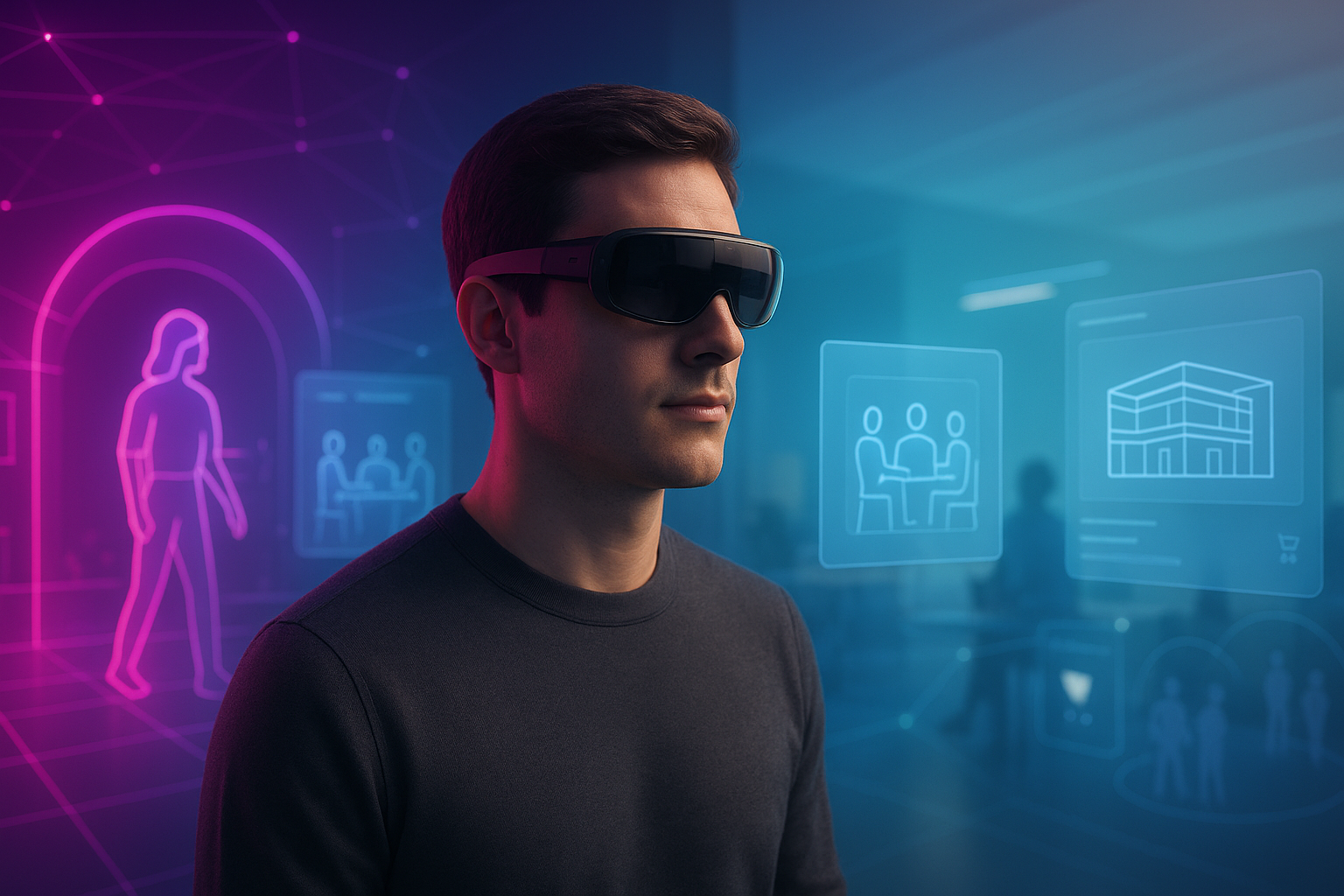
March 2026 will be remembered as the month the metaverse dream officially died—or did it? When Meta announced the shutdown of Horizon Worlds VR and revealed a staggering $73 billion in accumulated losses, headlines declared the metaverse era over. Yet paradoxically, market analysts still project the metaverse industry to reach $936 billion by 2030. This isn’t a contradiction—it’s a recalibration.
The metaverse 2026 story isn’t about failure; it’s about the brutal distinction between consumer fantasy and enterprise reality. While tech giants chased visions of virtual shopping malls and digital avatars hanging out in VR nightclubs, a quieter revolution was happening in factory floors, training centers, and design studios. The technology works. The business case is proven. But the winning applications look nothing like the metaverse we were promised. Here’s what actually survived—and what’s quietly thriving.
The Great Metaverse Pivot: Why Consumer Dreams Failed But Enterprise Solutions Flourish
The gap between vision and reality has rarely been more expensive or more instructive than Meta’s metaverse journey.
Meta’s $73 Billion Lesson: What Went Wrong with Social VR
Meta’s Reality Labs burned through $73 billion since 2020, yet Horizon Worlds never attracted more than a few hundred thousand monthly active users. Compare that to Meta’s traditional social platforms serving 3.5 billion users, and the disconnect becomes painfully clear.
The fundamental miscalculation? Assuming people wanted to strap headsets to their faces for social interactions they already manage effortlessly on smartphones. Users didn’t ask for legless avatars in virtual meeting spaces. They wanted lighter, cheaper hardware and actual reasons to abandon their phones. The technology delivered neither quickly enough.
Hardware barriers compounded the problem. Even with Meta subsidizing Quest headsets, asking consumers to invest $500 and tolerate motion sickness for unproven social experiences was a bridge too far. The few who tried Horizon Worlds found sparse virtual environments that felt more isolating than Facebook’s news feed. Social VR faced an adoption chicken-and-egg problem it never solved.
Enterprise Success Stories: Training, Simulation, and Industrial Applications
While consumer platforms floundered, enterprise metaverse applications delivered measurable returns. Walmart trained over one million employees using VR simulations. PwC found employees showed 275% higher confidence applying skills learned through VR compared to classroom training. Boeing reduced production time by 25% using AR-assisted assembly instructions.
The difference? Clear use cases with quantifiable ROI. Companies don’t need employees to love VR—they need them to learn faster, make fewer mistakes, and reduce travel costs. Accenture deployed 60,000 Meta Quest headsets for employee onboarding and training, reporting 47% higher engagement in virtual meetings compared to video calls.
Industrial applications proved equally compelling. Siemens uses digital twins for factory simulations, testing production line changes virtually before implementing them physically. BMW designs entire vehicles in mixed reality environments, enabling global engineering teams to collaborate on 3D models in real-time. These aren’t sexy consumer experiences—they’re grinding efficiency gains that justify significant investment.
Metaverse Market Reality Check: Where the $936 Billion Opportunity Actually Lives
The projected $936 billion metaverse market by 2030 tells a story dramatically different from Meta’s consumer vision.
The Four Sectors Driving Real Growth in 2026
Gaming remains the metaverse’s most successful consumer application, but even here, success looks different than predicted. Fortnite and Roblox pioneered persistent social experiences without requiring VR headsets. These platforms proved users want metaverse-like features—persistent identities, virtual economies, social spaces—but not necessarily immersive hardware.
E-commerce applications are gaining traction through AR try-before-you-buy experiences. IKEA’s app lets customers visualize furniture in their homes. Warby Parker’s virtual try-on increased conversion rates by 35%. These spatial computing applications blend digital layers into physical shopping without headsets.
Learning and training applications account for the largest enterprise spending. Medical students practice surgeries in VR. Construction workers learn safety protocols in risk-free virtual environments. The global VR training market alone is projected to reach $6.3 billion by 2027.
Advertising and brand experiences represent emerging opportunities. Nike’s virtual showrooms let customers explore products in 3D. Coca-Cola created branded experiences in gaming metaverses. These applications succeed because they enhance existing customer journeys rather than replace them.
Why Spatial Computing Replaced the Metaverse Buzzword
Notice how industry leaders now avoid saying “metaverse”? Apple launched Vision Pro as a spatial computing platform. Microsoft positions Mesh as mixed reality collaboration. This terminology shift reflects strategic repositioning from futuristic hype to present-day utility.
Spatial computing describes the practical implementation of post-screen interfaces—using AR, VR, and MR to interact with digital information anchored in physical or virtual space. It’s unglamorous, focused, and actually shipping in products today.
The rebranding acknowledges hard truths. Consumers weren’t waiting for fully immersive virtual worlds. They wanted specific problems solved: better remote collaboration tools, more effective training methods, enhanced visualization for complex data. When the industry stopped promising Ready Player One and started delivering practical tools, adoption accelerated.
Making Smart Metaverse Decisions in 2026: Practical Implementation Guide
For organizations navigating the metaverse 2026 landscape, success requires rejecting hype and focusing on proven applications.
High-ROI Use Cases vs. Money Pit Mistakes
Start with VR training for high-risk, high-cost scenarios. If your employees currently travel for training, handle dangerous equipment, or need hands-on practice with expensive machinery, VR probably delivers positive ROI. Calculate existing training costs—including travel, equipment, instructor time, and errors—then compare against VR development and hardware costs.
Digital prototyping works best for industries with expensive physical prototypes. Automotive, aerospace, and architecture firms report 30-50% reductions in prototype costs using virtual models. The key? You need existing 3D CAD workflows; don’t digitize just for metaverse’s sake.
Avoid vanity projects with fuzzy metrics. Virtual showrooms and branded metaverse experiences rarely justify costs unless they’re directly tied to conversion tracking. Don’t build a virtual headquarters because competitors did. Every implementation needs clear success metrics defined before development starts.
Focus on single use cases first. Companies that successfully implemented metaverse solutions started with targeted pilots—one training module, one product line, one specific workflow. Broad platforms attempting to revolutionize entire business models consistently fail. Narrow focus, measurable outcomes.
Technology Stack and Investment Requirements
Custom metaverse builds range from $10,000 for simple VR training modules to $400,000+ for complex multiplayer experiences. Factor in ongoing costs: cloud infrastructure, content updates, hardware refresh cycles, and technical support. Many organizations underestimate total cost of ownership by 200-300%.
Consider existing platforms before building custom. Microsoft Mesh integrates with Teams for enterprise collaboration. NVIDIA Omniverse enables industrial digital twins. These platforms offer faster deployment and lower costs than ground-up development, though with less customization.
Hardware requirements extend beyond headsets. High-quality VR experiences need powerful GPUs, high-speed networking, and specialized peripherals. For multi-user experiences, budget for dedicated servers and bandwidth. A 50-person VR training program might require $150,000 in hardware plus $3,000 monthly infrastructure costs.
Start with pilot programs testing core assumptions. Deploy with small user groups, measure actual versus predicted outcomes, and iterate before scaling. The most successful implementations began as three-month pilots with clear go/no-go criteria. Don’t commit to enterprise-wide rollouts until you’ve proven value with real users in real scenarios.
Frequently Asked Questions
Is the metaverse dead after Meta’s Horizon Worlds shutdown in 2026?
No, the metaverse evolved from consumer social VR to focused enterprise applications delivering measurable ROI. The market still projects $936 billion by 2030, driven by training, industrial applications, and e-commerce rather than social platforms.
What metaverse applications actually deliver ROI in 2026?
VR-based employee training, industrial simulations, digital product prototyping, and AR-enhanced design collaboration consistently show measurable returns, with companies reporting 25-275% improvements in specific performance metrics. Consumer social platforms largely failed to gain traction beyond gaming-focused experiences.
How much does it cost to implement metaverse solutions for business?
Custom metaverse builds range from $10,000 to $400,000 plus ongoing infrastructure costs for servers, networking, and hardware maintenance. Pilot programs using existing platforms like Microsoft Mesh or NVIDIA Omniverse offer lower-cost entry points starting around $5,000 for testing core use cases.
Why did Meta lose $73 billion on the metaverse?
Meta focused on consumer social VR that lacked sufficient demand, required expensive hardware consumers resisted buying, and couldn’t compete with the convenience of existing smartphone-based social platforms. Users consistently preferred familiar interfaces over headset-based virtual worlds for social interaction.
What’s the difference between metaverse and spatial computing?
Spatial computing is the practical industry term for post-screen interfaces using VR, AR, and MR to interact with digital information anchored in physical or virtual space. It represents the mature, focused evolution of broad metaverse concepts, emphasizing present-day utility over futuristic vision.
Conclusion
The metaverse 2026 narrative is about evolution, not extinction. Meta’s $73 billion investment and subsequent pivot revealed crucial lessons: consumers won’t adopt expensive hardware for social experiences their smartphones already provide, but enterprises will invest heavily in immersive technology that solves expensive problems. The $936 billion opportunity lives in training centers, factory floors, and design studios—not virtual shopping malls. For organizations exploring spatial computing in 2026, success means abandoning the hype of building virtual worlds and focusing ruthlessly on targeted applications with clear ROI. The metaverse didn’t die—it grew up.
Leave a Reply