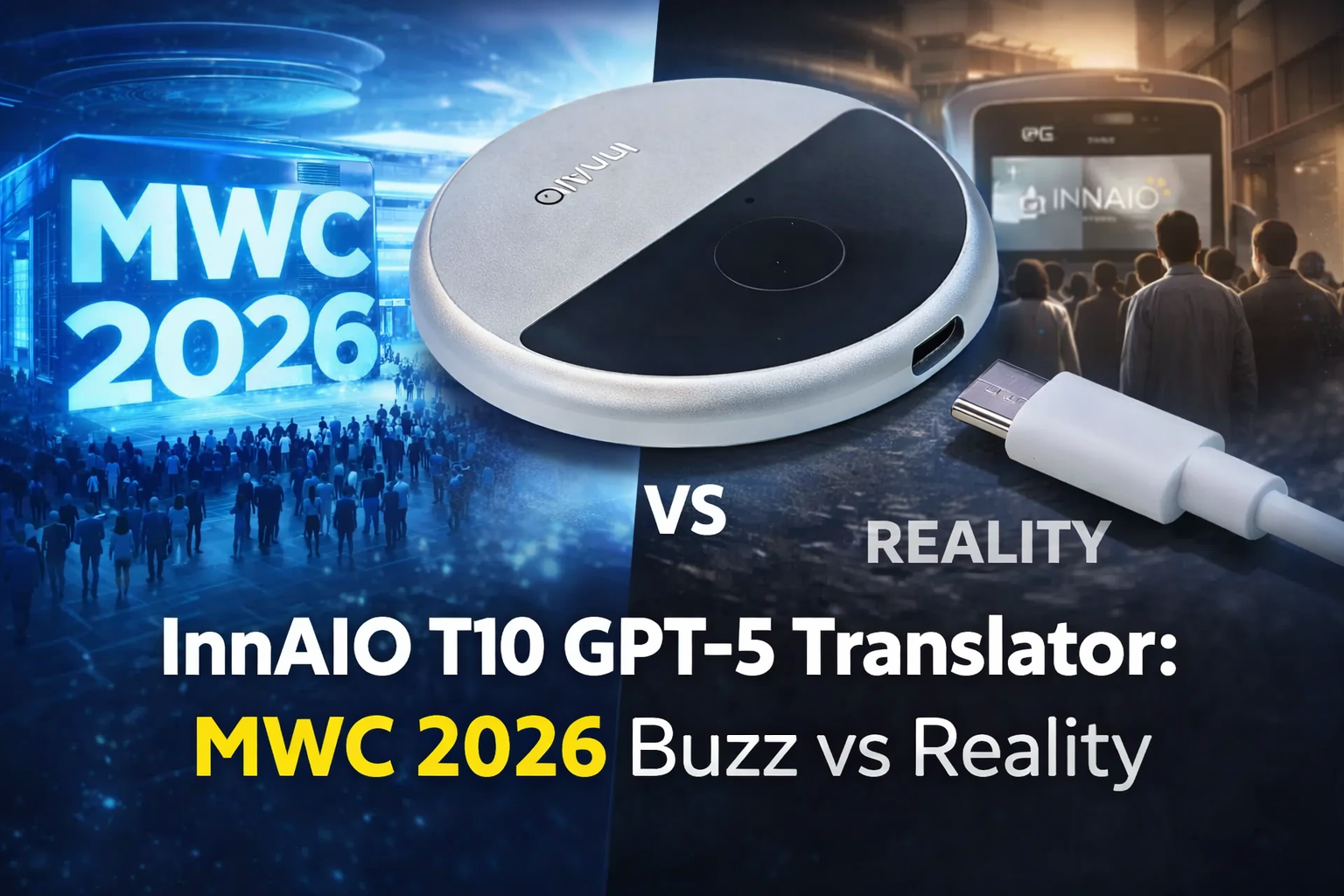
The tech world loves a good controversy, and the InnAIO T10 translator delivered exactly that at Mobile World Congress 2026. This tiny MagSafe-attachable device promised to revolutionize cross-language communication with GPT-5 power and voice cloning technology. But as early reviews trickled in, the story became less about innovation and more about transparency concerns.
The buzz started strong. A pocket-sized translator that clips to your phone and supposedly clones your voice in 140+ languages? It sounds like science fiction. Yet within days of its Barcelona debut, journalists were raising red flags about processing claims and company representatives were reportedly asking reviewers to hold back critical coverage. For anyone considering dropping money on the latest AI translation gadget, the InnAIO T10’s rocky launch offers valuable lessons about hype versus reality in consumer AI hardware.
InnAIO T10 Specifications and MWC 2026 Claims
GPT-5 and LLaMA Integration Features
InnAIO marketed the T10 as a GPT-5 translation device with impressive specifications. The device weighs just 30 grams and attaches magnetically to smartphones via MagSafe compatibility. According to the manufacturer, it supports over 140 languages with translation speeds of 0.5 seconds and 98% accuracy rates.
The GPT-5 integration powers the core translation engine, while LLaMA models handle specific dialect recognition and contextual nuances. Users access these features through a mandatory companion app that processes everything from simple phrase translations to full meeting transcriptions. The device includes cross-app translation for popular platforms like WhatsApp and Instagram, plus photo translation capabilities for signs and menus.
Battery life reaches 15 hours on a single charge, making it viable for full-day international travel. But here’s the catch: every feature requires constant app connectivity. Without your smartphone running the InnAIO app, the T10 becomes an expensive paperweight.
Voice Cloning Technology Explained
The standout feature generating MWC 2026 buzz was the voice cloning functionality. The system claims to replicate your voice patterns from just a 30-second audio sample. Once trained, the T10 can theoretically speak your translations in your own voice across all supported languages.
This addresses a legitimate pain point in translation technology. Standard machine voices often sound robotic or emotionally flat, potentially undermining business conversations or personal interactions. Voice cloning promises to maintain your vocal identity while speaking languages you’ve never learned.
However, the implementation raises questions. Does the voice cloning process happen on-device or in the cloud? InnAIO’s documentation remains vague on data handling practices. For a feature that requires recording and processing your unique vocal characteristics, this lack of clarity is concerning. Privacy-conscious users might reasonably wonder where their voice data lives and who can access it.
Real-World Performance and Industry Skepticism
Critical Reviews and Device Limitations
Gizmodo’s investigation into the InnAIO T10 revealed significant transparency issues. Reporters found that determining whether processing occurs on-device or through cloud servers proved nearly impossible. Company representatives provided contradictory information about the voice cloning translator functionality and data handling.
Most troubling was an alleged incident where an InnAIO representative requested that a journalist suppress critical review findings. This kind of pressure campaign rarely accompanies products with genuine confidence in their capabilities. Independent testers also noted that the mandatory app dependency creates friction in real-world usage scenarios.
The claimed 98% accuracy rate lacks independent verification. Translation quality varies dramatically based on language pairs and context complexity. While GPT-5 brings improvements over previous models, it’s not infallible. Users attempting technical or nuanced conversations may find the T10 struggles with industry-specific terminology or cultural idioms.
Comparison with Competing AI Translators
The portable AI interpreter market is crowded with established competitors. Timekettle’s W4 Pro offers similar functionality with clearer documentation about processing methods. Deutsche Telekom unveiled network-based translation solutions at MWC 2026 that don’t require additional hardware.
Perhaps most significantly, Honor’s Magic 7 Pro smartphone includes on-device translation powered by advanced AI models. This integrated approach eliminates the need for separate gadgets entirely. Why carry an additional device when your phone already handles translation with greater convenience?
The InnAIO T10 must justify its existence in this competitive landscape. Its MagSafe attachment offers minimal advantage over simply opening a translation app. The voice cloning feature is novel but represents a relatively narrow use case for most travelers. Business professionals conducting high-stakes negotiations might value vocal consistency, but casual tourists likely won’t notice or care.
AI Translation Market Context at MWC 2026
GPT-5 Translation Capabilities Assessment
OpenAI’s GPT-5 benchmarks show incremental rather than revolutionary multilingual improvements. MMLU testing across 13 languages demonstrates performance roughly equivalent to GPT-4 for most language pairs. The model handles context better and makes fewer grammatical errors, but these refinements don’t constitute a paradigm shift.
This matters because InnAIO heavily marketed GPT-5 integration as a killer feature. In reality, the difference between GPT-5 and GPT-4 powered translation is subtle in everyday use. You might notice slightly more natural phrasing or better idiom handling, but the experience isn’t transformatively different.
The MWC 2026 AI translator announcements revealed that cutting-edge model integration alone doesn’t guarantee market success. Execution, transparency, and user experience matter equally. InnAIO’s device includes impressive AI capabilities but stumbles on basic trust and usability factors.
Industry Shift Toward Integrated Solutions
MWC 2026 Barcelona showcased a clear industry trend: translation is becoming infrastructure rather than a standalone product category. Telecom providers are embedding real-time translation into network services. Smartphone manufacturers are integrating advanced language models directly into operating systems.
This multilingual communication device consolidation threatens standalone translator gadgets. When your phone, wireless earbuds, and cellular network all offer translation capabilities natively, dedicated hardware becomes redundant. The InnAIO T10 represents an older product philosophy in an industry rapidly moving toward seamless integration.
Device manufacturers must now justify why consumers should carry additional gadgets. Superior accuracy, offline functionality, or specialized features could differentiate products. Unfortunately, the T10’s app dependency and cloud processing undermine these potential advantages. It occupies an awkward middle ground: not portable enough to replace smartphone apps, not capable enough to justify the added complexity.
Conclusion
The InnAIO T10 translator embodies both exciting possibilities and frustrating realities in consumer AI hardware. Its voice cloning technology and GPT-5 integration demonstrate genuine innovation, yet transparency problems and app dependency limit practical appeal. As the translation market shifts toward integrated smartphone and network solutions, standalone devices face mounting pressure to justify their existence. Before purchasing any AI translation hardware, demand clear answers about data handling, verify accuracy claims through independent reviews, and honestly assess whether a dedicated device offers meaningful advantages over the apps already in your pocket. The future of translation is bright, but the InnAIO T10’s controversial debut suggests that future may not include many standalone gadgets.
Leave a Reply