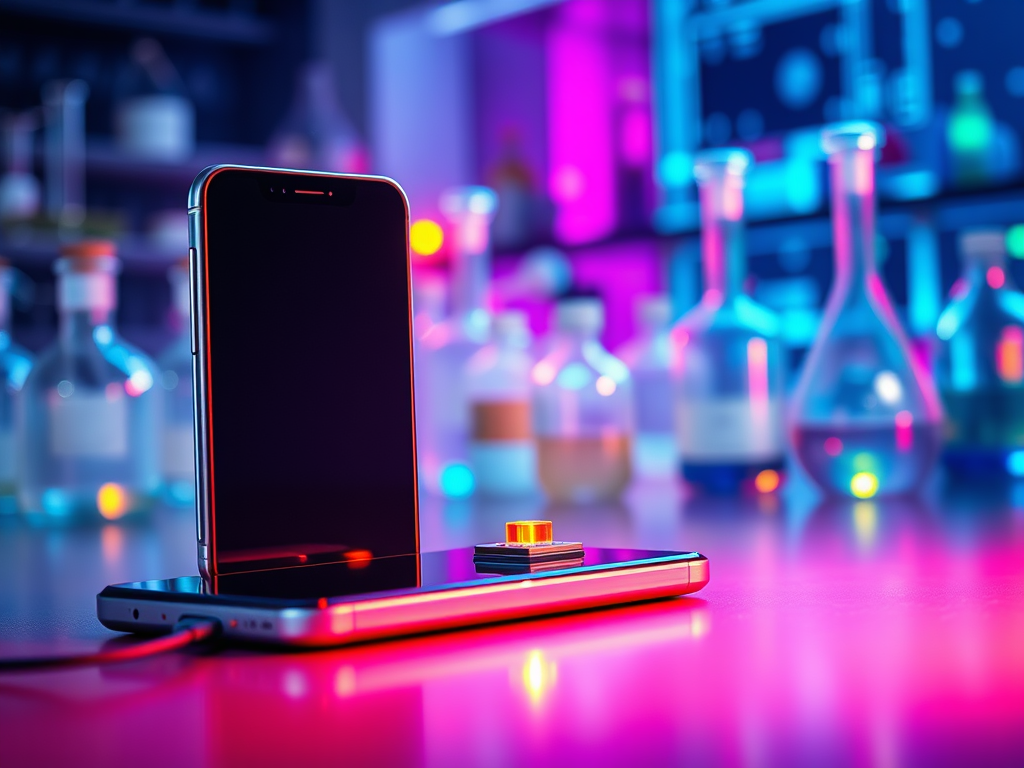
Imagine pointing your smartphone at your drink to check if someone slipped something into it, or scanning vegetables at the grocery store to detect harmful pesticides—all without sending samples to a lab. This isn’t science fiction anymore. Researchers at UC Davis have developed a miniature optical sensor smaller than a grain of sand that could turn every smartphone into a portable chemistry lab. Using the same manufacturing processes that create your phone’s chips, this breakthrough combines artificial intelligence with silicon photonics to deliver laboratory-grade chemical detection in a device you already carry in your pocket.
The timing couldn’t be more critical. With counterfeit medications flooding markets worldwide and concerns about food safety mounting, access to reliable, on-the-spot chemical testing has moved from luxury to necessity. Traditional spectrometers—the gold standard for identifying chemical substances—remain bulky and expensive, limiting their use to specialized facilities. This silicon-based sensor changes everything, shrinking technology that once filled laboratory benches into a space barely visible to the naked eye.
The Technology Behind Miniaturization: Silicon Meets Artificial Intelligence
How 16 Silicon Detectors Replace Bulky Laboratory Equipment
Traditional spectrometers separate light into different wavelengths using prisms or diffraction gratings—components that inherently require physical space. The UC Davis team took a radically different approach. Their spectrometer-on-a-chip uses 16 distinct silicon detectors, each featuring unique photon-trapping surface textures that respond differently to various wavelengths of light.
Think of it like having 16 different musical instruments, each naturally resonating with specific notes. Rather than mechanically separating light components, these textured surfaces capture mixed light signals simultaneously. The entire sensor measures just 5 micrometers by 5 micrometers—approximately 200 times smaller than the width of a human hair. This isn’t just miniaturization; it’s architectural reimagination.
Neural Networks Decode Mixed Light Signals With 8nm Resolution
Here’s where artificial intelligence becomes essential. Each detector captures overlapping wavelengths, creating what appears to be noise. A neural network trained on known spectral patterns reconstructs complete spectra from these mixed signals with remarkable precision.
The AI achieves 8-nanometer spectral resolution—comparable to benchtop laboratory instruments. It’s processing complexity that enables physical simplicity. Without AI decoding, this miniaturization approach wouldn’t work. The system essentially trades mechanical precision for computational intelligence, a trade-off that semiconductor manufacturers excel at scaling. This convergence of AI-driven detection with nanoscale silicon photonics represents a fundamental shift in how we can approach chemical analysis.
From Drug Detection to Food Safety: Real-World Applications
Detecting Spiked Drinks and Counterfeit Medications On-Site
The portable drug detection capabilities have immediate public safety implications. Systems like MobileDetect and NIRLAB already demonstrate that smartphone sensor technology can identify narcotics for law enforcement applications. This new sensor takes the concept further with dramatically reduced size and manufacturing costs.
For counterfeit medication detection, the impact could be life-saving. The World Health Organization estimates that 1 in 10 medical products in developing countries is substandard or falsified. Current smartphone-based authentication systems like SmartID verify packaging, but analyzing the actual chemical composition requires laboratory testing. A grain-sized sensor that identifies molecular signatures directly could protect millions from dangerous fakes while shopping at pharmacies or receiving medicines in remote clinics.
Pesticide Screening and Quality Control for Consumers
Food safety represents another compelling application. Researchers have already developed smartphone-based pesticide sensors using molecularly imprinted polymers and optical detection methods for fruits, vegetables, and water samples. The UC Davis sensor’s manufacturing scalability could make this technology affordable enough for everyday consumers.
Imagine scanning produce before purchasing, getting instant feedback about pesticide residues. Or verifying that organic claims match reality through chemical analysis rather than trusting labels alone. For developing regions where regulatory oversight remains limited, point-of-care testing capabilities could empower communities to monitor their own food and water safety. This democratization of analytical chemistry shifts power from centralized authorities to individual consumers making informed decisions.
Market Accessibility and Manufacturing Scalability Advantages
Leveraging Existing Chip Manufacturing Infrastructure
The sensor’s silicon-based architecture offers a game-changing manufacturing advantage. Unlike specialized optical components requiring dedicated production facilities, this sensor integrates seamlessly with standard semiconductor manufacturing processes—the same infrastructure producing billions of smartphone chips annually.
This compatibility isn’t just convenient; it’s transformative for scalability. Chip manufacturers have spent decades optimizing silicon processing, achieving consistency and yields that specialized optical component makers can’t match. The sensor essentially hitchhikes on this mature ecosystem, potentially reaching mass production faster than technologies requiring custom manufacturing solutions. Lab-on-chip technology typically struggles with the valley between prototype and production; silicon-based approaches have a proven bridge.
Cost Comparison With Current Portable Detection Devices
Current portable alternatives illustrate why cost matters. Handheld drug detectors like the MX908 mass spectrometer cost $30,000-$50,000. Portable near-infrared spectrometers run $5,000-$20,000. These price points restrict access to well-funded organizations—law enforcement agencies, regulatory bodies, and established laboratories.
Smartphone-integrated sensors could collapse these costs by orders of magnitude. While exact pricing remains speculative until commercial production, silicon chip economics suggest consumer-level affordability becomes plausible. If detection sensors cost what smartphone cameras cost to manufacture—single-digit dollars—the technology becomes accessible to individuals, small businesses, and resource-limited regions currently excluded from chemical testing capabilities. That accessibility shift represents the difference between niche tool and transformative technology.
Conclusion
The UC Davis miniature optical sensor demonstrates how converging technologies—silicon photonics, artificial intelligence, and smartphone ubiquity—can fundamentally democratize capabilities once confined to specialized laboratories. By manufacturing these sensors using existing chip infrastructure, researchers haven’t just shrunk laboratory equipment; they’ve created a path toward putting chemical analysis tools in billions of pockets worldwide. Whether detecting spiked drinks, verifying medication authenticity, or screening food safety, the applications extend far beyond technical novelty into daily life impact. As this technology matures from research prototype to consumer product, we’re witnessing not just hardware miniaturization, but the expansion of who gets to ask—and immediately answer—”What’s really in this?”
Leave a Reply