Introduction
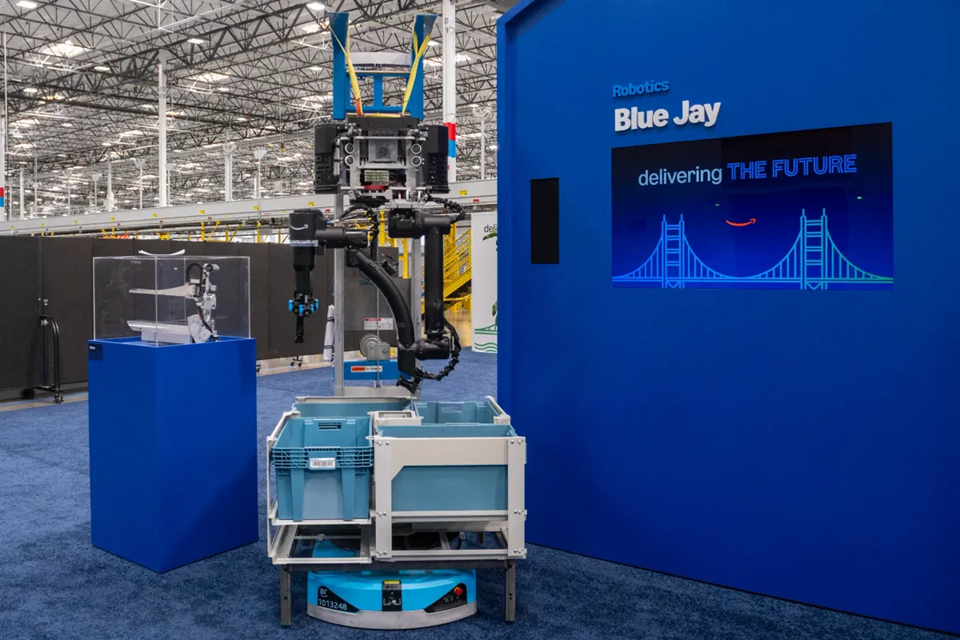
In October 2025, Amazon unveiled its Blue Jay robot with considerable fanfare. The multi-armed system promised to revolutionize same-day delivery by collapsing three separate workstations into one seamless operation. By January 2026, it was gone. The Amazon Blue Jay robot lasted barely three months in active deployment before the company quietly pulled the plug.
Table of Contents
- Introduction
- Why Amazon’s Blue Jay Robot Failed So Quickly
- The Technology Gap Between Promise and Reality
- What Blue Jay’s Shutdown Reveals About Amazon’s Automation Strategy
This isn’t just another failed tech experiment. Amazon operates over 750,000 robotic systems across its fulfillment network and invests billions annually in automation. When the world’s largest e-commerce company can’t make a warehouse robot work after compressing development timelines and throwing considerable resources at the problem, it reveals something fundamental about the gap between automation promise and reality. The shutdown raises uncomfortable questions about AI-powered logistics, the true cost of warehouse efficiency, and whether same-day delivery technology has hit a wall that even Amazon’s engineering prowess can’t scale.
Why Amazon’s Blue Jay Robot Failed So Quickly
Cost and Manufacturing Complexity Derailed Deployment
Blue Jay’s multi-armed design created a manufacturing nightmare. Each unit required precision engineering to coordinate multiple robotic arms working in parallel within tight physical constraints. Sources familiar with the project indicated that per-unit costs exceeded initial projections by substantial margins, making the economics untenable at scale.
Amazon needed hundreds or thousands of units to meaningfully impact same-day delivery operations. But the manufacturing complexity meant slow production ramps and quality control challenges. Compare this to simpler single-function robots already deployed across Amazon’s network—systems that do one task reliably rather than attempting three simultaneously. When fulfillment center managers calculated throughput improvements against capital expenditure and maintenance requirements, Blue Jay couldn’t justify its price tag. The company faced a harsh reality: cheaper automation solutions delivered better ROI.
Integration Challenges in Same-Day Fulfillment Centers
Same-day delivery warehouses operate under brutal time pressures. Packages arrive in unpredictable volumes, sizes, and conditions. Orders must move from receipt to truck in hours, not days. Blue Jay struggled with this variability.
The robot was designed to handle sorting, consolidation, and loading in one workstation. But real-world packages don’t cooperate with ideal specifications. Damaged boxes, irregular shapes, and rushed handling created constant exceptions that Blue Jay’s AI couldn’t process quickly enough. Human workers still needed to intervene for problem cases, eliminating the promised efficiency gains. Warehouse managers reported that Blue Jay created bottlenecks rather than eliminating them. In fulfillment operations, throughput is everything. A system that promises consolidation but delivers congestion won’t survive long, regardless of how impressive it looks in controlled demonstrations.
The Technology Gap Between Promise and Reality
AI Advances Couldn’t Overcome Real-World Warehouse Conditions
Amazon accelerated Blue Jay development using AI simulations and digital twin technology, cutting the typical three-year development cycle to just one year. The compressed timeline created a fundamental problem: insufficient exposure to the chaotic conditions of high-volume fulfillment operations.
Warehouse environments punish technology in ways labs can’t replicate. Dust, temperature swings, package debris, and the constant physical demands of 24/7 operations expose weaknesses quickly. Blue Jay’s sophisticated AI could handle simulated scenarios brilliantly but faltered when faced with the accumulated edge cases of real fulfillment centers. The robot’s computer vision struggled with poor lighting. Its gripping mechanisms couldn’t adapt to packaging variations fast enough. These aren’t software problems you patch—they’re fundamental engineering challenges that require extensive field testing Amazon didn’t allow time for.
From Prototype to Production: The Condensed Timeline Problem
In January 2026, Amazon executives admitted something they hadn’t disclosed in October 2025: Blue Jay was essentially a prototype. The October announcement positioned it as deployment-ready technology, not an experimental system. This gap between marketing presentation and operational readiness proved critical.
Prototype systems belong in pilot programs with controlled conditions and realistic expectations. Instead, Blue Jay faced immediate pressure to deliver measurable efficiency gains in demanding same-day fulfillment environments. The condensed development timeline meant Amazon skipped the gradual scaling process that typically identifies and resolves integration issues before full deployment. Workers and managers expected production-ready technology. They got a beta test disguised as a solution. When that reality became undeniable, Amazon had to choose between investing additional years refining Blue Jay or cutting losses and moving forward. They chose the latter.
What Blue Jay’s Shutdown Reveals About Amazon’s Automation Strategy
Technology Migration: From Blue Jay to Flex Cell and Orbital
Amazon didn’t simply abandon Blue Jay’s underlying technology. The company immediately reassigned engineering teams to existing projects: the floor-mounted Flex Cell system and the modular Orbital fulfillment architecture. This reveals a calculated pivot rather than outright failure.
Blue Jay attempted to solve too many problems simultaneously with one complex system. Amazon’s new approach embraces modularity—specialized robots handling specific tasks within flexible configurations. The Flex Cell system incorporates some of Blue Jay’s manipulation technology but in a simpler, more reliable package. Orbital represents a fundamental rethinking of same-day fulfillment center design, moving away from centralized systems like the Local Vending Machine approach Blue Jay was meant to support. The message is clear: Amazon still believes in warehouse automation, but has shifted toward proven, scalable solutions over ambitious multi-function systems.
The $10 Billion Question: ROI Pressure on Robotics R&D
Morgan Stanley projects Amazon could save $10 billion annually from warehouse robotics by 2030. That enormous potential return creates intense pressure to deploy only automation that delivers measurable ROI quickly. Blue Jay couldn’t meet that threshold.
Amazon operates over 1 million deployed robots today, from simple drive units to sophisticated picking systems. Each one must justify its cost through labor savings, increased throughput, or error reduction. In this environment, experimental systems face ruthless evaluation. Blue Jay’s failure highlights how even Amazon—with virtually unlimited capital and engineering talent—must answer to basic economics. The company won’t hesitate to kill projects that can’t demonstrate clear paths to scaled profitability. As the physical AI sector races toward a projected $1 trillion market by 2035, investors should note: hype doesn’t equal deployment, and impressive demonstrations don’t guarantee warehouse viability.
Conclusion
The Amazon Blue Jay robot lasted six months from announcement to discontinuation, a reminder that warehouse automation must clear unforgiving thresholds before earning its place on fulfillment center floors. Amazon’s immediate pivot to Flex Cell and Orbital systems demonstrates calculated strategy—absorbing lessons, preserving useful technology, and refocusing resources on solutions that can scale. For logistics managers and technology executives watching this space, Blue Jay offers a critical lesson: compressed development timelines and AI advantages can’t substitute for the unglamorous work of field testing under real operational pressures. The physical AI revolution will transform warehousing, but the path runs through practical engineering and ruthless ROI calculations, not ambitious prototypes that promise too much too soon.
Leave a Reply