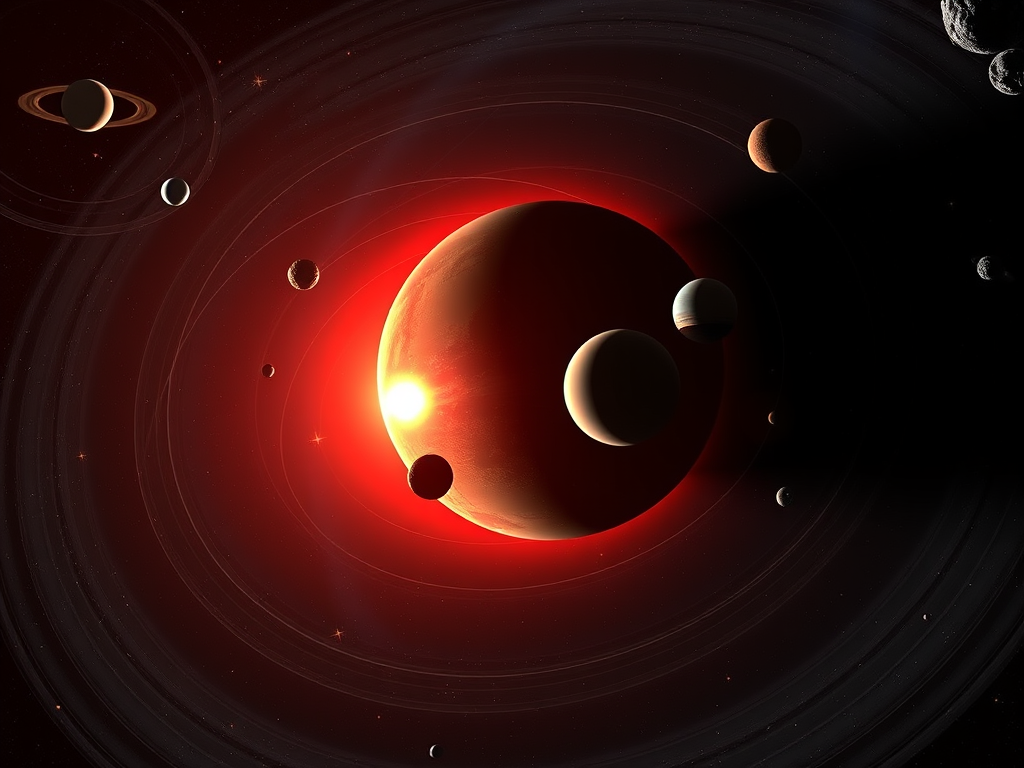
Picture everything astronomers thought they knew about how planets form—now flip it inside out. That’s exactly what scientists encountered when they studied LHS 1903, an impossible solar system located 116 light-years from Earth. Published in Science journal on February 12, 2026, this discovery has planetary scientists scratching their heads and reaching for their textbooks.
The arrangement is bizarre: rocky planets sit close to the star, gas giants occupy the middle zone, and then—defying all conventional wisdom—another rocky planet orbits beyond the gas giants. This configuration is the astronomical equivalent of finding a basement on the top floor of a building. In our solar system and virtually every other system we’ve studied, rocky planets huddle near their star while gas giants drift farther out. LHS 1903 breaks that pattern spectacularly.
Why does this matter? Because with over 6,000 exoplanets discovered since the 1990s, we’ve never seen anything quite like this. The finding forces astronomers to reconsider whether the planetary arrangement we see in our own cosmic neighborhood is the universal standard—or just one possibility among many. If systems like LHS 1903 can exist, what other “impossible” configurations might be hiding in our galaxy?
What Makes LHS 1903 So Strange
The Bizarre Planetary Order
LHS 1903 hosts four confirmed planets orbiting a red dwarf star, the most common stellar type in our universe. The system’s layout reads like a planetary formation rulebook written backward: rocky-gas-gas-rocky. To understand why this seems wrong, think about how astronomers believed solar systems assembled for decades.
In our cosmic backyard, Mercury, Venus, Earth, and Mars cluster close to the Sun, while Jupiter, Saturn, Uranus, and Neptune orbit farther out. This pattern repeats across the galaxy with remarkable consistency. Scientists built entire theories around this arrangement, explaining that rocky planets form where it’s hot enough for metals and silicates to condense, while gas giants need the colder outer regions to accumulate their massive hydrogen and helium atmospheres.
LHS 1903 throws that neat model into chaos. The outermost planet, dubbed LHS 1903 e, is a super Earth discovery measuring 1.7 times Earth’s radius. It’s firmly rocky in composition, yet it orbits beyond two substantial gas giants. According to traditional planet formation theory, this world has no business existing where it does.
Why This Arrangement Shouldn’t Exist
Standard planetary formation models operate on a temperature gradient principle. Close to a young star, intense heat vaporizes volatile compounds like water and methane, leaving only heat-resistant materials like iron and rock. This “frost line” concept explains why Earth is made of rock and metal while Jupiter is predominantly gas.
Beyond the frost line, where temperatures drop significantly, water ice and other volatiles can condense. These icy particles act as seeds, rapidly accumulating material until they’re massive enough to gravitationally capture hydrogen and helium—creating gas giants. The model predicts that once you move past the gas giant zone, there simply isn’t enough solid material left to build rocky planets.
Yet LHS 1903 e exists in precisely this “forbidden” zone. The planet shouldn’t have access to the dense, rocky building blocks needed for its composition. It’s as if someone built a sandcastle in a region where only snow should exist. The discovery challenges the sequential logic that seemed so ironclad: hot inner regions make rocky planets, cold outer regions make gas giants, end of story.
The Gas-Depleted Formation Hypothesis
Sequential Planet Birth Explained
Faced with this planetary puzzle, researchers developed a radical new hypothesis: what if the planets in LHS 1903 didn’t form simultaneously? Traditional models assume all planets in a system coalesce from the same protoplanetary disk at roughly the same time, experiencing identical environmental conditions.
The new planet formation theory suggests LHS 1903’s worlds assembled sequentially, one after another, from the inside out. The innermost rocky planet formed first, gobbling up nearby material. Then the two gas giants developed in the cooler middle zone, capturing the abundant hydrogen and helium still swirling in the disk.
Here’s where timing becomes critical: by the time conditions were right for the fourth planet to form in the outer reaches, millions of years had passed. The protoplanetary disk had evolved dramatically. Stellar winds from the young red dwarf had blown away most of the lightweight gases, leaving behind primarily heavier elements. Without abundant hydrogen and helium to accumulate, the fourth planet could only form from the remaining rocky and metallic debris—creating a super-Earth instead of another gas giant.
How Timing Changed Everything
This “gas-depleted formation” mechanism hinges on the disk’s evolution over time. Protoplanetary disks don’t remain static—they gradually dissipate as material either accretes onto planets, falls into the star, or gets blown away into space. The process typically takes between 3 to 10 million years.
LHS 1903 e likely formed during the disk’s twilight years, when most of the gas had already departed. Think of it like arriving at a buffet near closing time: the selection is limited to what’s left. In this case, what remained were solid materials—dust, ice, and rocky particles—but very little of the hydrogen and helium needed to build a gas giant.
This timing-dependent formation challenges the assumption that a planet’s composition depends solely on its distance from the star. Instead, when a planet forms might matter just as much as where it forms. The hypothesis explains not just LHS 1903’s strange arrangement, but potentially opens the door to understanding other unusual planetary configurations astronomers have struggled to explain.
Implications for Planetary Science
Rethinking Planet Formation Around Red Dwarfs
Red dwarfs comprise roughly 75% of all stars in the Milky Way, making them the galaxy’s dominant stellar population. If alternative formation mechanisms like the one proposed for LHS 1903 occur commonly around these stars, it dramatically expands the diversity of possible planetary architectures.
Red dwarfs differ from Sun-like stars in crucial ways. They’re cooler, dimmer, and their protoplanetary disks may dissipate at different rates. The LHS 1903 planetary system offers the first concrete evidence that these differences can produce radically different outcomes. Planets around red dwarfs might follow entirely different formation pathways than those around solar-type stars.
This matters enormously for the search for habitable worlds. Red dwarfs are prime targets for exoplanet hunters precisely because they’re so abundant. Understanding how diverse their planetary systems can be helps astronomers know where to look for potentially life-bearing worlds and what conditions those planets might experience.
The Search for More Inside-Out Systems
The obvious question: is LHS 1903 a cosmic fluke, or have we simply overlooked similar systems? Astronomers are now combing through existing exoplanet data with fresh eyes, searching for other inside out solar system configurations that might have been dismissed as observational errors or misinterpreted.
Detection methods have improved dramatically in recent years. NASA’s TESS mission and ground-based surveys continue discovering thousands of new exoplanets annually. With each detection, scientists gather more data about planetary masses, sizes, orbits, and compositions—the very information needed to identify unusual arrangements like LHS 1903’s.
Some researchers predict that as detection techniques improve, we’ll find that supposedly “impossible” systems are more common than anyone imagined. Our solar system’s tidy arrangement might represent just one solution to the complex physics of planet formation—not the universal blueprint we once assumed it to be.
Frequently Asked Questions
What is the LHS 1903 solar system?
LHS 1903 is a planetary system located 116 light-years from Earth, containing four planets orbiting a red dwarf star. Its unusual rocky-gas-gas-rocky arrangement contradicts the standard planetary order observed throughout our galaxy.
Why is LHS 1903 called an impossible solar system?
Scientists call it “impossible” because it has a rocky super-Earth orbiting beyond two gas giants, defying the temperature-based formation model where rocky planets form close to stars and gas giants form farther out. This configuration shouldn’t exist according to traditional planet formation theories.
How did the impossible solar system form?
Researchers propose a gas-depleted formation mechanism where planets formed sequentially rather than simultaneously. The outermost rocky planet likely formed millions of years after the inner planets, when most gas had dissipated from the protoplanetary disk, leaving only solid materials to coalesce.
What is a super-Earth?
A super-Earth is an exoplanet larger than Earth but smaller than Neptune, typically with a rocky composition similar to our planet. LHS 1903 e measures 1.7 times Earth’s radius and represents this planetary class.
What does this discovery mean for planet formation theory?
The discovery forces scientists to expand their models beyond simple temperature-based formation, acknowledging that timing and sequential formation can produce diverse planetary arrangements. It suggests the universe may contain far more varied planetary architectures than previously imagined, especially around red dwarf stars.
Conclusion
The impossible solar system LHS 1903 proves that the universe still holds surprises that challenge our most fundamental assumptions. This inside-out arrangement isn’t just an astronomical curiosity—it’s evidence that planetary formation operates through more diverse mechanisms than we recognized. As telescopes grow more powerful and detection methods more sophisticated, expect more “impossible” discoveries that force us to rewrite the rules. Perhaps the real lesson is humility: our solar system’s familiar pattern may be just one note in a far richer cosmic symphony than we ever imagined.
Leave a Reply