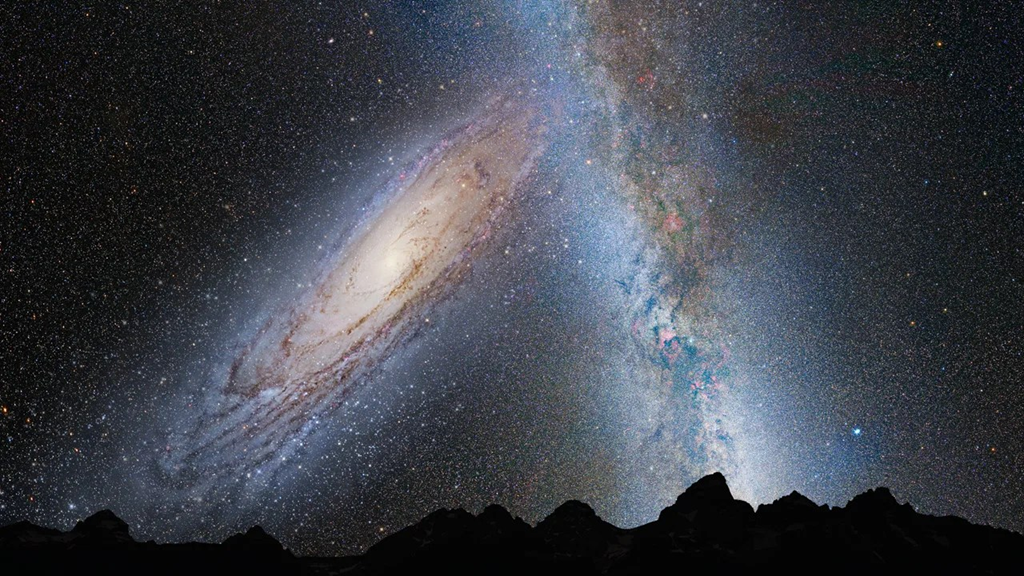
Astronomers have confirmed evidence of a major Milky Way collision that occurred when the universe was barely 1.5 billion years old, fundamentally reshaping our understanding of our galaxy’s violent early history. Using precise age measurements of ancient globular clusters, researchers identified traces of a merger with a massive dwarf galaxy named Low-energy-Kraken-Heracles (LKH), marking the earliest confirmed collision in our galaxy’s formation timeline.
This discovery pushes back the date of our galaxy’s most ancient merger by more than 2 billion years. Published in a January 2026 study on arXiv, the research reveals that the Milky Way experienced dramatic upheaval far earlier than previously documented. The collision deposited hundreds of millions of stars into the inner regions of our galaxy, fundamentally shaping the structure we observe today. For decades, astronomers have debated whether traces of such ancient mergers existed in the stellar fossil record. This study provides the first unambiguous proof.
The Discovery: Reading Star Cluster Fossils
Hubble’s Precision Age Dating
Globular clusters serve as cosmic time capsules, preserving information about the galaxy’s formation history. These ancient, densely packed star systems orbit the Milky Way’s halo and contain some of the oldest stars in the universe. Researchers analyzed these clusters using Hubble Space Telescope data, employing sophisticated techniques to determine their precise relative ages through detailed analysis of stellar populations.
The team focused on what astronomers call age-metallicity sequences—patterns that reveal when stars formed and their chemical composition. Younger stars typically contain more heavy elements (higher metallicity) because they form from gas enriched by previous stellar generations. By mapping these sequences in globular clusters, scientists can reconstruct a timeline of galactic events spanning billions of years.
Three Distinct Age-Metallicity Sequences
The research revealed something unexpected: three completely distinct age-metallicity sequences within the Milky Way’s globular cluster population. Each sequence represents a separate galactic building block that merged to form our galaxy. The first sequence traces back to the Milky Way’s original progenitor—the proto-galaxy that existed before any major mergers.
The second sequence corresponds to the well-known Gaia-Enceladus merger, which occurred approximately 10 billion years ago. But the third sequence was the revelation. Dating to 12.3 billion years ago—just 1.5 billion years after the Big Bang—this newly identified pattern represents the LKH collision. The distinct chemical signatures and ages of these three populations provide irrefutable evidence that the Milky Way assembled through multiple violent encounters during its youth.
What the LKH Collision Means for Galaxy Formation
A Massive Early Merger
The LKH progenitor wasn’t a minor galaxy. With a stellar mass similar to Gaia-Enceladus at approximately 500 million solar masses, this was a substantial dwarf galaxy that profoundly impacted the developing Milky Way. When galaxies collide, they don’t crash like solid objects. Instead, their stars pass through each other while gravitational forces reshape both galaxies.
The LKH collision deposited most of its material in the inner 6 kiloparsecs of the Milky Way—roughly 20,000 light-years from the galactic center. This means that a significant fraction of stars in our galaxy’s inner regions originated in a completely different galaxy. The merger likely triggered intense star formation as gas clouds collided and compressed, creating new generations of stars from the turbulent mixing of galactic material.
Cosmological Simulations Confirm the Finding
The discovery wasn’t made in isolation. Researchers cross-referenced their findings with the Auriga simulations—sophisticated computer models that recreate galaxy formation from cosmological initial conditions. Multiple Milky Way analogs in these simulations reproduce the same pattern: three distinct age-metallicity sequences emerging from the merger history.
These simulations validate predictions that young galaxies experience one to four significant mergers during their formation phase. The universe was smaller and denser in its youth, making galactic collisions far more common. What we’re seeing in the Milky Way isn’t unusual—it’s the standard construction process for large spiral galaxies. The ancient galaxy merger pattern identified in our cosmic neighborhood likely played out countless times across the universe during this epoch.
Rewriting the Milky Way’s Merger Timeline
From Gaia-Enceladus to LKH
Before this discovery, the Gaia-Enceladus collision dominated discussions of the Milky Way’s merger history. Occurring 10 billion years ago, this event was considered the most ancient major merger astronomers could definitively identify. The ongoing Sagittarius dwarf merger, which began roughly 6 billion years ago and continues today, represented the most recent significant encounter.
Now the timeline has been rewritten. The LKH collision predates Gaia-Enceladus by more than 2 billion years, occurring during what astronomers call the epoch of proto-galaxy formation. This was a chaotic period when the first galaxies were assembling from smaller building blocks. The Milky Way experienced its most violent construction phase earlier than previously documented.
The Inner Galaxy’s Complex History
The inner Galaxy presents a complex puzzle for astronomers practicing stellar archaeology. This region likely contains debris from multiple early mergers, with material from different progenitor galaxies thoroughly mixed over billions of years. The LKH collision represents the cleanest identification of the most massive early contributor to the Milky Way’s structure.
Disentangling these overlapping populations requires sophisticated analysis of globular clusters and individual stellar orbits. The discovery suggests that other ancient merger remnants may lurk in the data, waiting for similarly precise age-dating techniques to reveal them. Each new identification adds another chapter to our understanding of Big Bang galactic formation and the violent processes that built the galaxy we call home.
Conclusion
This discovery marks the first unambiguous identification of a significant merger during the proto-Galaxy’s earliest evolution, settling previous debates about ancient collision events. The confirmation that the Milky Way collision with LKH occurred just 1.5 billion years after the Big Bang reveals that galactic construction began far more violently and rapidly than previously understood. As researchers continue analyzing globular clusters with next-generation telescopes like the James Webb Space Telescope, more chapters of our galaxy’s turbulent infancy will emerge from the stellar fossil record, painting an increasingly detailed picture of how cosmic structures assembled during the universe’s dramatic youth.
Leave a Reply