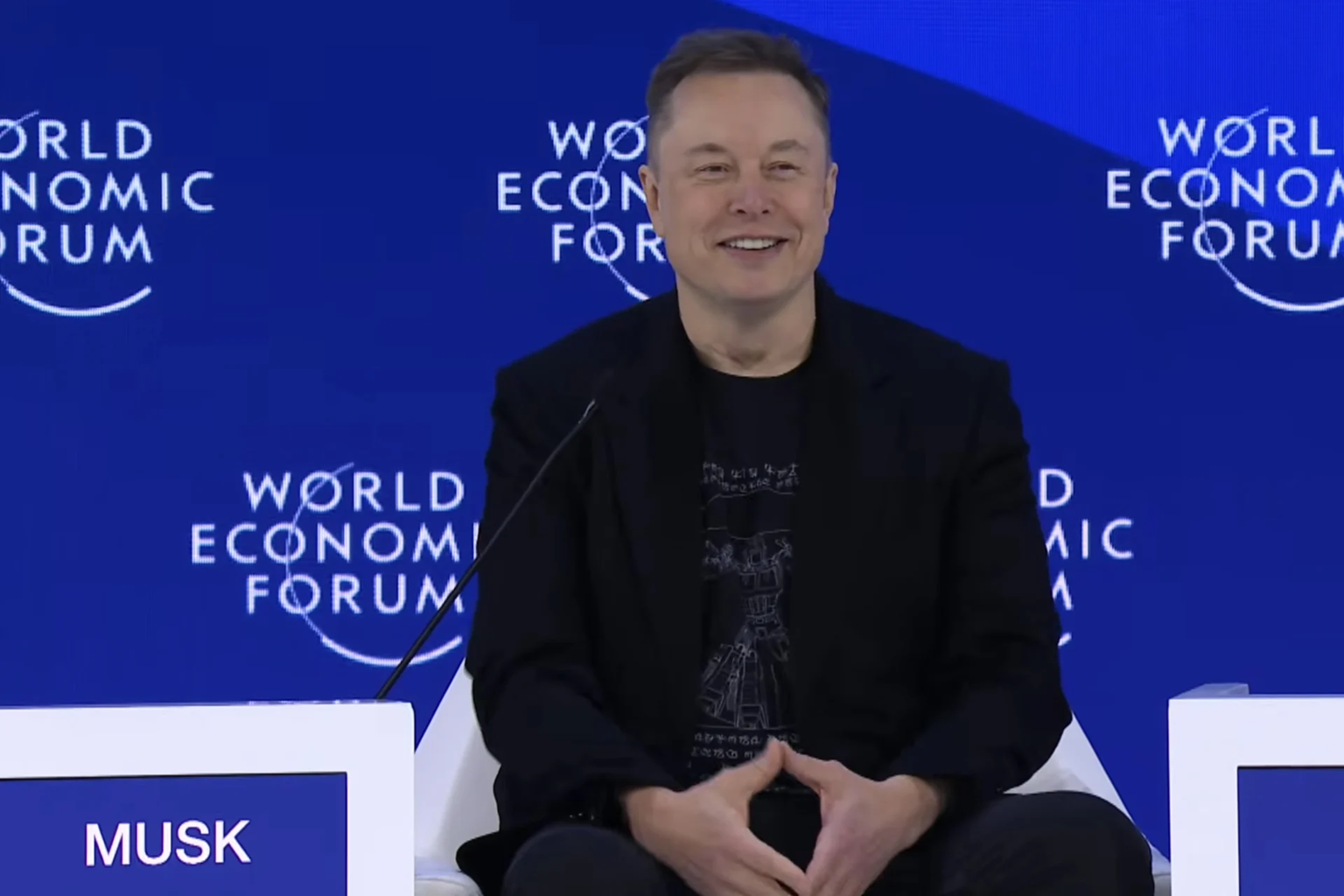
The race to superhuman AI 2026 just got a dramatic deadline. Speaking virtually at the World Economic Forum in Davos on January 22, 2026, Elon Musk declared that artificial intelligence will surpass individual human intelligence by year’s end—just months away. More strikingly, he predicts AI will exceed the collective intelligence of all humanity by 2030 or 2031. If accurate, we’re witnessing the final chapters before machines fundamentally outthink us.
But Musk didn’t stop with intelligence predictions. He announced that Tesla’s Optimus humanoid robots would become available for public purchase by late 2027, potentially placing a household assistant in millions of homes within two years. These twin predictions—cognitive and physical—represent either visionary forecasting or the latest in a pattern of ambitious timelines from tech’s most prominent futurist. The stakes couldn’t be higher: either we’re approaching civilization’s most profound transformation, or we’re watching hype outpace reality once again.
Table of content
The Dual-Track Timeline: AI Intelligence and Physical Robotics
When Superhuman AI Arrives: 2026-2031 Predictions
Musk’s Davos timeline splits artificial general intelligence into two milestones. First, AI surpassing any single human’s intelligence by December 2026—essentially eight months from his announcement. Second, achieving AGI timeline superiority over humanity’s combined knowledge by the end of this decade.
This acceleration stands in stark contrast to consensus views. Google DeepMind CEO Demis Hassabis estimates AGI arriving in 5-10 years, while researcher surveys consistently point to 2040. Interestingly, those same surveys showed 2060 predictions before large language models emerged, suggesting the field routinely underestimates progress. Musk’s forecast compresses even the accelerated timelines, banking on exponential gains that haven’t slowed despite compute constraints.
The distinction between individual and collective intelligence matters enormously. An AI smarter than one person could revolutionize personal productivity and decision-making. But AI superintelligence exceeding all human knowledge combined represents something fundamentally different—a force potentially capable of solving problems beyond our current comprehension, from climate engineering to molecular medicine.
Tesla Optimus Robot Commercialization Path to 2027
On the robotics front, Musk outlined a clear commercialization path for Tesla Optimus robots 2027. The company currently deploys Optimus units performing simple tasks in Tesla factories—basic material handling and part sorting. By late 2026, Musk expects these robots to handle complex industrial work autonomously, setting the stage for consumer sales approximately one year later.
The progression from factory floor to living room follows Tesla’s familiar playbook: perfect technology in controlled environments before mass-market release. Tesla’s manufacturing expertise gives it potential advantages in scaling production that pure robotics companies lack. The company already produces vehicles at massive scale, and Musk argues similar manufacturing infrastructure could produce humanoid robots at volumes rivaling automotive production.
Yet the leap from industrial use to domestic utility presents challenges beyond manufacturing. Home environments demand far more sophisticated decision-making than factory workflows. Your kitchen doesn’t have the standardized layouts, predictable tasks, or safety protocols of a production line. The robot that sorts parts might struggle to navigate a cluttered living room or adapt to your family’s unique routines.
Market Reality Check: From Factory Floor to Living Room
Current Optimus Deployment and Technical Challenges
Tesla’s current Optimus deployment reveals both progress and limitations. The robots operate for approximately two hours on battery power before requiring recharges—hardly sufficient for full-day household assistance. Videos from Tesla factories show Optimus units moving containers and performing repetitive tasks, but experts note significant teleoperation during demonstrations, raising questions about true autonomy levels.
Industry veteran Rodney Brooks, co-founder of iRobot, dismisses the vision of humanoid household assistants as “pure fantasy thinking.” His skepticism stems from decades watching robotics promises exceed delivery. The gap between controlled demonstrations and reliable real-world performance has frustrated the field repeatedly. Even tasks humans consider simple—folding laundry, loading dishwashers, navigating stairs with obstacles—require remarkable perception, planning, and manipulation capabilities robots haven’t mastered.
Battery constraints particularly limit practical utility. Two-hour operation means domestic robots spend more time charging than working. Breakthrough battery technology could change this equation, but such advances haven’t materialized despite decades of investment across industries from automotive to consumer electronics.
Humanoid Robot Market Forecasts and Price Projections
The humanoid robot market sits at an inflection point. Valued between $1.83-3.28 billion in 2024, industry projections forecast explosive growth to $35-76 billion by 2032-2033. These estimates assume successful commercialization by major players including Tesla, Boston Dynamics, and emerging Chinese manufacturers.
Musk targets a $20,000-30,000 price point for consumer Optimus units, positioning them as comparable to mid-range vehicles. Current prototypes cost substantially more—estimates range from $30,000 to $150,000 depending on specifications. Achieving consumer pricing requires massive manufacturing scale and component cost reductions that may take years to materialize.
Compare this to the broader robot automation market, which already generates significant revenue in industrial applications. Companies willingly pay six-figure sums for specialized factory robots with proven ROI. Consumer markets demand different economics entirely. At $25,000, a household robot competes with hiring human help, major home renovations, or simply doing tasks yourself. The value proposition must be overwhelming to justify the expense.
The Credibility Question: Musk’s Track Record vs. Expert Skepticism
Historical Timeline Accuracy and Industry Concerns
Musk’s prediction history provides important context for evaluating his 2026 superhuman AI forecast. In 2024, he tweeted that useful humanoid robots would arrive by 2025—a timeline that hasn’t fully materialized even as we approach mid-2026. His autonomous vehicle predictions have similarly shifted rightward, with “full self-driving” remaining years behind original projections despite significant technical progress.
This pattern doesn’t necessarily invalidate his vision, but it suggests adjusting timelines accordingly. Musk consistently identifies correct technological directions while underestimating implementation challenges. Autonomous vehicles are improving dramatically. Humanoid robots are becoming more capable. AI is advancing at remarkable speed. The question isn’t whether these technologies arrive, but precisely when and in what form.
Critics point specifically to teleoperation evidence in robot demonstrations. If humans remotely control robots during showcases, true autonomy remains further away than marketing suggests. The distinction matters enormously for commercialization. Remote operation works for specific industrial tasks but won’t scale to millions of home environments with unpredictable conditions and tasks.
What Energy Constraints Mean for AI Progress
Musk identifies electrical power as the fundamental constraint on artificial general intelligence development, displacing previous concerns about computing chips. This perspective aligns with data center power consumption trends, where AI training runs increasingly hit energy limits before computational ones. The shift matters because energy constraints require different solutions than chip shortages.
His proposed solution? Space-based solar-powered data centers within 2-3 years. The concept leverages uninterrupted solar exposure beyond Earth’s atmosphere and eliminates land use concerns. Whether this timeline proves realistic depends on launch costs, assembly capabilities, and thermal management solutions that don’t yet exist at necessary scale.
Meanwhile, China’s deployment of over 1,000 gigawatts of solar capacity annually demonstrates the scale of terrestrial solutions. If AI development genuinely depends on energy availability, global renewable buildout becomes an AGI timeline factor rarely discussed in technical AI papers. The convergence of energy policy and AI superintelligence development represents an underappreciated dynamic shaping our technological future.
Conclusion
Musk’s superhuman AI 2026 prediction and late-2027 robot availability compress timelines beyond expert consensus, but directional trends support accelerated progress. While technical challenges in battery life, autonomy, and manufacturing scale suggest more gradual rollout than promised, the combination of advancing AI capabilities and serious robotics investment from major companies indicates significant developments ahead. Whether the AGI timeline hits in 2026, 2030, or 2040, the convergence of intelligence and physical capability will define the coming decade—and Musk’s predictions ensure we’re watching closely as each deadline arrives.
Leave a Reply